

18 December 2025/ Sri Lanka Brief
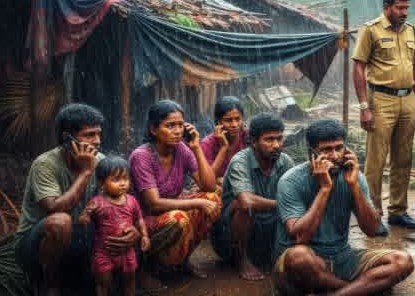
The state mechanism deployed to provide relief to residents of Dehiattakandiya in the Ampara District, affected by Cyclone Ditwah, was crippled not only by the force of nature, but also by the extreme irresponsibility of the country’s major telecommunications companies.
Breakdown of Communication Infrastructure
Given the size and population of the Ampara District, hundreds of mobile phone towers belonging to leading telecommunications providers—Dialog, Mobitel, SLT, Hutch, and Airtel—are spread across the region. The highest concentration of towers is in densely populated areas such as Ampara town, Kalmunai, Samanthurai, and Akkarapattu.
In recent years, several companies have adopted a cost-cutting practice of sharing a single tower among multiple operators. However, this practice proved disastrous during Cyclone Ditva.
According to the Disaster Management Centre and the Ampara District Administrator’s Office, the inability to communicate with remote areas—particularly Dehiattakandiya—was the primary obstacle to conducting effective relief operations.
As a professional journalist present at the District Secretariat during this period, I witnessed these difficulties firsthand.
Total Collapse of Information Flow
- Communication blackout: Mobile phone towers were non-operational, leaving officials unable to assess where assistance was most urgently needed.
- Delayed medical and humanitarian aid: The lack of communication caused hours-long delays in identifying patients requiring emergency treatment and communities in need of food and water.
A Fatal Obstacle to Relief Coordination
Even after the critical first 72 hours following the disaster, neither the Ampara Governor nor the Disaster Management Unit was able to establish communication with the Dehiattakandiya area.
Relief centres expected to coordinate emergency responses were rendered completely ineffective. Authorities had no way of determining:
- Whether people were trapped under collapsed houses
- Who required urgent medical attention
- Which areas needed immediate humanitarian assistance
Despite knowing that communication is vital during disasters, telecommunications companies failed to ensure the continuous operation of their infrastructure.
Violation of the Rights of Prepaid Consumers
The majority of Sri Lankan mobile phone users are prepaid customers. These consumers pay in advance for uninterrupted services.
The failure to maintain generators and battery backup systems, which are mandatory for emergency operations, constitutes a clear violation of consumer protection laws. Power outages cannot be cited as an excuse.
Today, people are paying with their lives because companies focused solely on profit have neglected to maintain critical infrastructure in vulnerable areas.
Legal and International Responsibility
This failure is not merely a technical lapse—it amounts to a violation of the fundamental right to life.
- International standards: Disaster communication is mandatory under regulations set by the International Telecommunication Union (ITU).
- Local law: Telecommunications companies are bound by license conditions issued by the Telecommunication Regulatory Commission of Sri Lanka (TRCSL). These conditions require continuity of service during national emergencies.
Consumer associations and regulatory authorities must act decisively against companies that violated these obligations and directly disrupted relief efforts.
Lessons Learned and Urgent Solutions
Cyclone Ditwah exposed critical weaknesses in Sri Lanka’s disaster preparedness. Immediate action is required to prevent a recurrence:
- Strengthen communication networks:
Install solar power systems or upgraded generators to ensure mobile towers remain operational during disasters. - Establish emergency communication systems:
Deploy ham radio networks or satellite phones at Divisional Secretariat offices to ensure connectivity when mobile networks fail. - Public awareness and training:
Educate communities on alternative information-sharing methods, such as relaying messages through Grama Niladharis when communication systems collapse.
The central lesson from Cyclone Ditva is clear: communication is the bridge between life and death during natural disasters.
Key Demands
✅ Conduct an independent investigation into the telecommunications companies that crippled the Ampara Disaster Management Unit
✅ Make a minimum of 72 hours of uninterrupted power supply mandatory for every mobile phone tower
✅ Enforce corporate accountability proportional to the prepaid fees collected from consumers
Technology exists to save lives—not to abandon people in moments of crisis.
Formal Complaint to the Telecommunication Regulatory Commission of Sri Lanka
To:
Director General
Telecommunication Regulatory Commission of Sri Lanka (TRCSL)
No. 27, Pare Lane
Colombo 08
Subject: Complaint regarding the breakdown of communication networks and disruption of relief services in the Ampara District due to Cyclone Ditva
Dear Sir/Madam,
We submit this complaint on behalf of affected citizens regarding the severe disruption of communication services in the Dehiattakandiya area of the Ampara District following Cyclone Ditva.
Key Issues
- 72-hour communication blackout:
For three days following the disaster, the Ampara District Administrator and Disaster Management Unit were unable to contact Dehiattakandiya. All major telecommunications networks were inactive. - Disruption of relief services:
The absence of communication prevented authorities from identifying affected locations and coordinating emergency relief, resulting in life-threatening delays. - Violation of consumer rights:
Most consumers in Ampara are prepaid users. Despite advance payments, companies failed to maintain backup power systems, breaching customer agreements and consumer protection laws. - Breach of legal obligations:
Telecommunications operators violated TRCSL license conditions and international disaster communication standards requiring service continuity during emergencies.
Our Demands
- Immediate initiation of a formal investigation into this communication failure
- Mandatory installation of alternative energy systems capable of sustaining tower operations for at least 72 hours
- Legal penalties and consumer compensation under the Consumer Affairs Act and Telecommunications Act
We urge the Commission to recognize that companies funded by public payments and prepaid fees must not abandon the public during national emergencies.
Copies to:
- Ampara District Secretary
- Director, Disaster Management Centre (Ampara)
- Consumer Affairs Authority
- Human Rights Commission of Sri Lanka
- Parliamentary Petitions Committee
(Published in the public interest)
Chandana Liyanaarachchi
Translated to English by SLB From Gamini Basnayake (Facebook)