
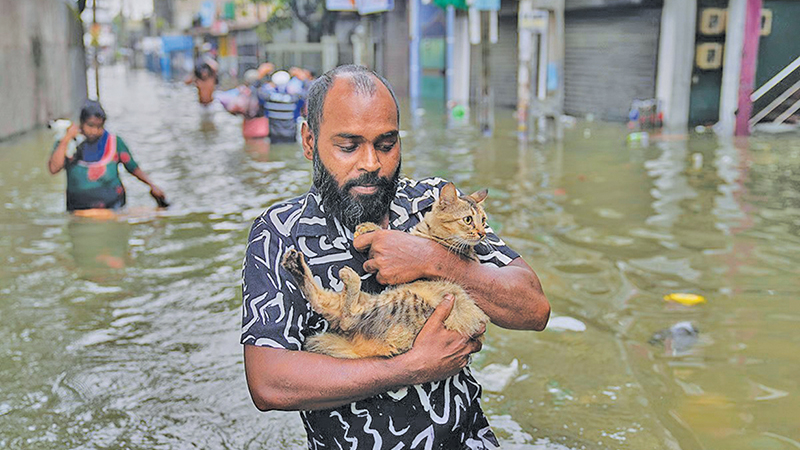

Seeing three cyclones at once is a significant meteorological event, not a common occurrence. The recent triple cyclone was also significant in another aspect – they formed near the Equator, where storms are generally rare. The impact of Cyclone Ditwah alone has led to what UNICEF calls a “fast-moving humanitarian emergency” — a crisis evolving so rapidly that it overwhelms the capacity for an immediate response.
Meteorologists worldwide use modern technology, such as satellites, weather radars and computers to track tropical cyclones as they develop. Tropical cyclones can be challenging to forecast weeks in advance or even closer to landfall, as they can suddenly weaken or change their course. Meteorologists use state-of-the-art technologies and develop modern techniques such as numerical weather prediction supercomputer models to forecast how a tropical cyclone evolves, including its movement and change of intensity; when and where one will hit land and at what speed.
The National Meteorological Services of the concerned countries then issue official warnings. Meteorological services in most of the affected countries warned of a deep depression and high winds around November 25-26, though a cyclone was not specifically mentioned in most bulletins. Around 85 tropical storms form annually over the world’s warm tropical oceans. Among these, just over half (45) become tropical cyclones/hurricanes/typhoons. Proportionately, of the 85 tropical storms, 72 percent form in the Northern Hemisphere, and 28 percent in the Southern Hemisphere.
Hit and miss science
Climate Change and Global Warming have made storm forecasts a hit and miss science. Due to unpredictable conditions from global warming, Australia’s Bureau of Meteorology scrapped seasonal cyclone forecasts, saying they were less reliable due to the “changing climate”. It is believed that Climate Change can strengthen tropical cyclones, while a hotter planet creates more intense monsoon rains because warmer air holds more moisture. Scientists said that countries facing these weather events must enhance their prediction capacities.
In Bangladesh, a tropical cyclone claimed at least 300,000 lives in 1970. It was one of the deadliest natural disasters in recorded history. Casualty rates from more recent storms in Bangladesh have reduced dramatically, thanks to improved forecasting and an early warning system that spans radio and TV broadcasts, text messages and volunteers that patrol the streets to alert their communities. Still, both developed and developing countries can fall prey to hurricanes and cyclones – Hurricane Katrina in the US in 2005 being a prime example. However, one major difference is that developed countries can bounce back faster as they do not generally lack funds for reconstruction.
The UN World Meteorological Organisation (WMO) has raised alarm over rising extreme rainfall across Asian nations, including Indonesia, the Philippines, Sri Lanka, Thailand, and Vietnam. A recent attribution study by the Grantham Institute confirms that human-induced Climate Change has intensified wind speeds and rainfall in recent typhoons, adding to the urgency for decisive climate action.
Asia is warming almost twice as fast as the global average, according to the WMO. The WMO states that the formation of tropical storms in latitudes near the equator (outside their usual range) and increasingly violent monsoons “is something that was not seen very often before,” but is now becoming an “unusual and worrying” pattern. Clare Nullis, spokesperson for the UN agency, told the media in Geneva that this shift of cyclones towards areas where local communities lack experience in dealing with them has amplified the damage.
Rising temperature
A report by the Inter-governmental Panel on Climate Change (IPCC) concludes that as temperatures continue to rise, the Southern and Southeastern parts of the Asian Continent will experience more intense rainfall and a “significant increase” in flooding in monsoon areas. These analysts said that coastal cities in the region will see “significant increases” in average annual economic losses due to flooding. Ocean Warming in the region (also above the global average, according to the WMO) brings more energy and moisture into the atmosphere, increasing the likelihood of more intense storms and much heavier rainfall. While scientists caution that it is not yet possible to attribute every specific cyclone to climate change, there is a strong consensus that rising temperatures increase the frequency and severity of these weather events.
This year, this trend has been compounded by the simultaneous presence of a La Niña event (the phenomenon that occurs when cooling in the central Pacific shifts heat westward, intensifying monsoon rains in Southeast Asia) and a negative Indian Ocean Dipole (warmer-than-normal waters near Indonesia that draw in moisture and intensify rainfall). These two natural phenomena do not usually reach their peak at the same time because they originate from different ocean basins, follow their own circulation patterns, and tend to occur at different times. Their convergence amplifies the potential for more violent rainfall and potentially more destructive storms.
Addressing these climate issues will cost a lot of money. At COP30, nations pledged to triple Climate Finance contributions (a target of mobilising up to US$ 1.3 trillion annually by 2035). They also let Big Oil get away without imposing any restrictions for the moment. Observers said that for vulnerable communities already losing lives and livelihoods, this delay of at least one decade is unacceptable. Moreover, other factors have also intensified the impact of cyclonic winds and floods, such as deforestation, deficiencies in protection systems, and a lack of funding to improve emergency preparedness.
The economic consequences of these weather events in the region are also enormous. In 2024, seasonal flooding caused US$ 25 billion in damage in Asia-Pacific, according to a study by the insurance brokerage Aon, a figure that could be far exceeded in 2025. So far, Vietnam estimates losses exceeding US$ 3 billion this year; in Thailand, the damage from the November floods could subtract up to one-tenth of the annual GDP, while Indonesia reports an annual average of U$ 1.37 billion in disaster losses, a figure that experts fear will increase this year. The affected Asian countries will have to spend billions of dollars to get livelihoods and infrastructure back on track. (UN, Agencies)
( Sunday Observer)