
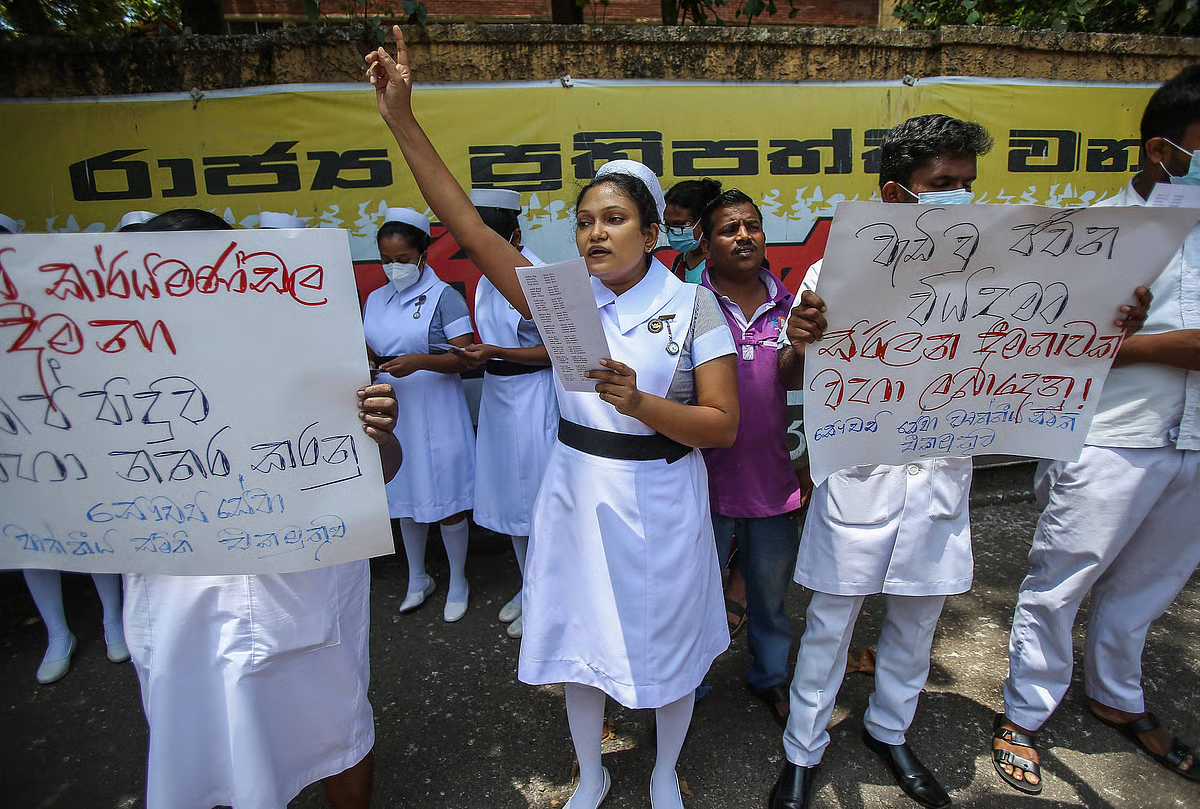

With the dawn of the new year, the government unveiled what may be described as two “revolutionary” Cabinet decisions. While public attention was largely absorbed by controversies surrounding social media scandals, crime, and political drama, Cabinet Decisions No. 4 and 5 issued on 5 January 2026 went almost unnoticed. Yet embedded within these decisions are policy shifts that have the potential to fundamentally erode the very foundations of the direction of Sri Lanka’s free state healthcare system.
Two “Revolutionary” Proposals
The first decision relates to advanced diagnostic services in government hospitals. According to the Cabinet paper, the government lacks sufficient funds to purchase CT scanners, MRI scanners, angiography machines, and to establish cardiac care units and automated laboratory facilities. The procurement process is also described as complex and time consuming. As a solution, it is proposed that these diagnostic services be provided using equipment or units owned by the private sector, with payments made by the government under an accepted mechanism for the services provided. This arrangement is to be implemented under the framework of Public–Private Partnerships (PPPs).
The second decision concerns dialysis units for patients with kidney disease, currently operating in 80 government hospitals. Under the new proposal, the private sector will be responsible for supplying dialysis machines, consumables, dialysis fluids, maintenance, and overall operation. The government will provide infrastructure and clinical consultancy services, while committing to make regular payments to the private providers—again within a PPP framework.
A Direct Challenge to the Foundations of Free Healthcare
Sri Lanka’s state run healthcare system has, since the British colonial period, been built on the principle of free access at the point of delivery. Following the devastating malaria epidemic of the 1930s, which claimed nearly 10% of the population, the expansion of public healthcare became a national necessity. Today, more than 95% of in patients and around half of all out patients receive treatment through the state healthcare system.
What makes this system remarkable is the extraordinarily high return it delivers for relatively low public expenditure. The World Bank and the World Health Organization have repeatedly recognized Sri Lanka’s healthcare model as one that achieves excellent outcomes at minimal cost. Throughout its history, the private sector has never functioned as a capital investor within the core of the state healthcare system.
Profit Versus Service: An Inherent Conflict
Public healthcare is fundamentally service oriented. The state invests not for short term financial gain, but to create a healthy population. The private sector, by contrast, operates on the principle of profit—whether short term or medium term. Integrating these two fundamentally different objectives within a single system inevitably generates conflict.
Any private entity investing in healthcare services on behalf of the state will seek guaranteed revenue or assured profit margins over a defined period. The government, in turn, becomes contractually bound to make these payments. If fiscal constraints prevent timely payments, private providers may restrict or suspend services. The ultimate victims of such disruptions will be patients who depend on uninterrupted access to care.
The British Experience: Lessons from Margaret Thatcher’s Reforms
The dangers of introducing market driven principles into a public healthcare system are clearly illustrated by the British experience. It was under Prime Minister Margaret Thatcher that private sector concepts and PPP style mechanisms were introduced into the UK’s National Health Service (NHS).
Although the NHS remains nominally free at the point of use, the quality and accessibility of services have deteriorated dramatically. Patients often wait years for routine surgeries. Emergency services are chronically deficient, particularly on weekends, and it is not uncommon for patients to wait more than 12 hours to see a doctor. Meanwhile, healthcare expenditure has soared. The UK’s per capita health spending now exceeds USD 6,000, compared to approximately USD 260 in Sri Lanka.
Is There Really a Lack of Capital?
The Cabinet paper claims that private financing is necessary because the government lacks funds to purchase essential medical equipment. This claim does not withstand scrutiny. In 2025, about 80% of the of the funds allocated to the Ministry of Health went unutilized and were returned to the Treasury, according to an official revelation by the Ministry, itself.
Furthermore, the assertion that equipment procurement is too complex ignores a critical reality: procuring long term technical services from private entities is far more complicated, administratively burdensome, and vulnerable to corruption than purchasing equipment outright through established procurement procedures.
The Future of Sri Lanka’s Free Healthcare System
At first glance, these proposals may appear to offer pragmatic, short term solutions to resource constraints. In reality, they risk initiating a long term process that could erode the very foundations of Sri Lanka’s free healthcare system. Once profit driven mechanisms become embedded, reversing course becomes exceedingly difficult.
For this reason, these Cabinet decisions demand serious public debate. Healthcare professionals, policymakers,and citizens alike must engage critically with these proposals. Protecting Sri Lanka’s free healthcare system is not merely a professional or political concern—it is a collective national responsibility.
Dr Ajith Amarasinghe, (Dr Ajith Amarasinghe is Medical Specialist who holds an MBA in Healthcare Services from The Manipal University.)