
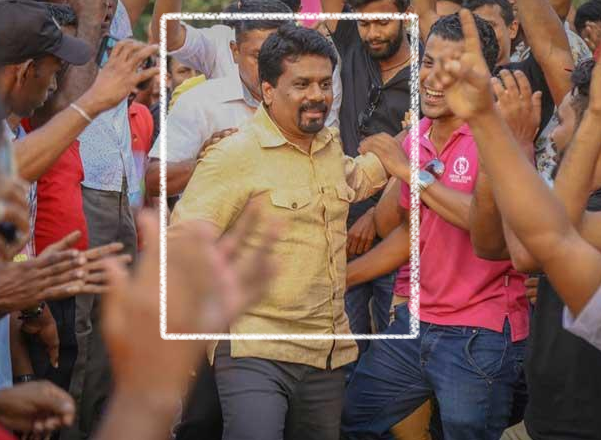

President Anura Kumara Dissanayake has now completed 18 months of his term. He has another 42 months ahead. He stands as both the centre and the symbol of the National People’s Power (NPP) government.
When he visits Jaffna, he is often photographed walking alone on an empty road early in the morning, wearing a short T‑shirt, stopping to chat casually with local residents. On another day, he is seen travelling in ordinary clothes, smiling and conversing with tea pluckers in estate fields, dressed fashionably in hats. On the 14th, we saw the President celebrating the New Year with a rural family affected by Cyclone Ditwa. He held the daughter’s hand and spoke warmly with the family.
This kind of symbolic political imagery is not new to this country.
Maithripala Sirisena once sat on a wall gazing at the sky. On another occasion, he drank tea in a modest roadside café or chatted in a Tamil household in Jaffna. Ranil Wickremesinghe posed for photographs while engaging young women in political discussion and circulated images of himself walking with his wife in matching outfits. Mahinda Rajapaksa kissed the ground upon arrival at the airport and carried babies at public rallies.
What all four share is the performance of a carefully constructed humility—much like Buddhist monks staging images of sacred austerity as political theatre.
But real politics lies elsewhere. The people did not endorse Anura Kumara because he bowed to monks or wore a double‑pocket shirt.
The events of 2022 mattered because Anura Kumara and the NPP emerged as symbols of the people’s struggle and aspirations. The NPP rose to power because it aligned itself with the demand for a new political culture unleashed by that historic uprising.
A comparable rupture occurred in 1986 in the Philippines, when a mass uprising toppled the Marcos dictatorship and brought Corazon Aquino to power. That revolt was broadcast live across the country, just as the 2022 struggle was here.
Aquino’s government restored civil liberties and moved the country towards democracy. Yet her presidency lasted only one term. During her tenure, there were at least seven failed military coup attempts, with the attempts of 1987 and 1989 being particularly violent. These severely weakened her government.
Then came the 1991 eruption of Mount Pinatubo, followed by major earthquakes that devastated the economy and hampered relief efforts. Severe daily power cuts lasting eight to twelve hours crippled industry and public morale. Land disputes surrounding her family’s Hacienda Luisita estate, unfulfilled promises of agrarian reform, and corruption involving officials in her administration eroded her “people power” image.
We can easily make substitutions.
Replace Aquino with Anura Kumara. Replace military coup attempts with the Joint Opposition, the Medical Association, the Electrical Engineers’ Association, and similar forces. Replace Mount Pinatubo with Cyclone Ditwa. Replace the Middle East war‑triggered fuel crisis with our electricity crisis.
While corruption under the NPP is not as entrenched as during the Rajapaksa era, it is already contributing to growing public disillusionment.
Education reforms were announced, yet no action was taken against a former Speaker who submitted forged educational certificates. A JVP leader reportedly possessing personal wealth of Rs. 270 million serves as a minister, owns shares in Dhammika Perera–linked companies, and holds cryptocurrencies that are illegal in Sri Lanka. The housing controversy involving Minister Lal Kantha—who lectures civil servants on Marxism while conducting Lenin‑reading rallies—is another scandal. Minister Kumara Jayakody faces corruption charges in court. More recently, USD 2.5 million was lost to hackers due to negligent cross‑border payment practices. At the very least, the Finance Secretary should accept responsibility and resign. Sri Lanka has become fertile ground for cybercrime due to weak digital security.
The President’s media director, Suriyabandara, allegedly assaulted two journalists while on assignment for Sirasa. What is even more shameful than the ban on Deepachelva’s books is the laundering of nationalist artists through state platforms.
The government’s democratic reform record is poor. State media continues to function as a political tool. The Social Media Protection Act, previously condemned by the NPP, remains unrepealed. The legislation replacing the Prevention of Terrorism Act has drawn sharp domestic and international criticism. There is no timeline for the promised independent prosecutor’s office. Provincial council elections, delayed for over a decade, remain unscheduled. Provincial identifiers have been removed from vehicle licence plates in an act of anti‑devolution posturing. Another pledge of democratic governance lies unfulfilled.
These weaknesses could still be addressed. There remains over three and a half years. Yet the NPP seems to lack both the mechanism and political will to manage the damage and course‑correct.
If the JVP’s tradition of criticism and self‑criticism still operates within its political council, one wonders how much internal turbulence it would cause.
The government’s opaque handling of the coal procurement scandal marks a decisive shift. It signals the erosion of the NPP’s commitment to a new political culture.
Renovating bus terminals, railway stations, or building expressways does not constitute political change. The Rajapaksa era saw unprecedented highway development, yet it failed because corruption was systemic and political arrogance rampant.
Chile’s 2022 political change was widely discussed here—the election of 35‑year‑old leftist Gabriel Boric. While Boric enacted meaningful pro‑people reforms, he failed to deliver constitutional change. Crime rose, racial tensions increased, and in 2026, the presidency was won by far‑right Trump‑style candidate José Antonio Kast.
Boric’s ascent resembles Anura Kumara’s in important ways. His base was largely the student‑youth movement and the urban progressive middle class—social forces that are inherently volatile.
In contrast, Brazil’s Lula da Silva rests on a solid working‑class base, strong support among the poor, and organised social movements. Colombia’s Gustavo Petro draws strength from trade unions, students, and Indigenous and Afro‑Colombian communities. Both practise coalition politics.
The Rajapaksas relied on Sinhala‑Buddhist extremism. The UNP once had a broad urban‑rural base until it was hollowed out under Ranil Wickremesinghe. The SLFP succeeded by integrating five major Sinhala left‑centre social forces.
We know that the National People’s Power functions largely as a front for the JVP. The critical question remains: if the JVP’s traditional base is only three per cent, what is the real social foundation of this government?
The survival of the NPP depends more on its own performance than on the weakness of an incoherent opposition. Hungary’s Viktor Orbán once appeared invincible, yet was undone by a political movement that began only two years earlier.
That is why it is unwise to dismiss the opposition as defeated and irrelevant, dear Red comrades.