
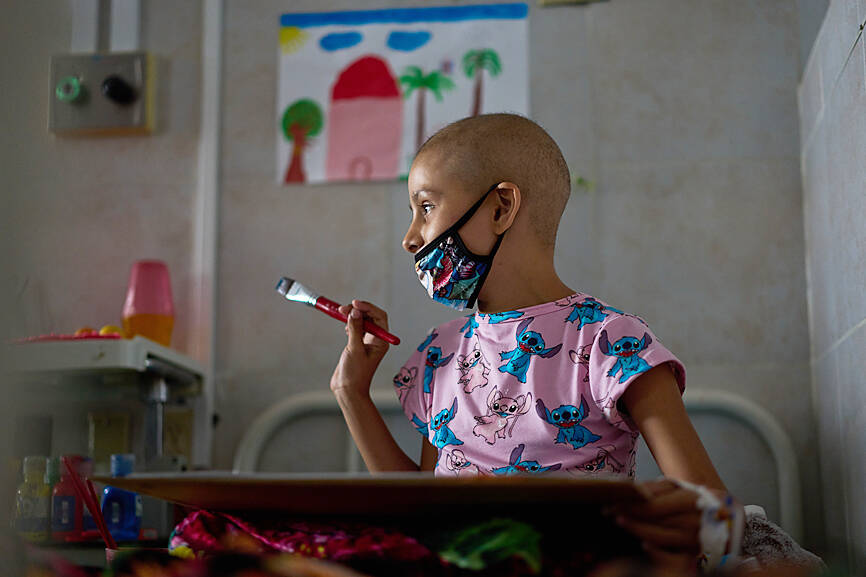

Image: A child with cancer holds a paintbrush at the National Institute of Oncology and Radiology in Havana on Friday.(AP photo)
As a convoy of humanitarian aid loaded with food, medicine, and solar panels prepared to set sail from Mexico to Cuba this week, organizers delivered a stark message: “Solidarity cannot be blocked” . The flotilla’s departure underscores a grim reality—Cuba, an island nation of 11 million people just 90 miles off the coast of Florida, is facing a deepening health crisis that international observers and even some U.S. lawmakers are calling inhumane and strategically indefensible.
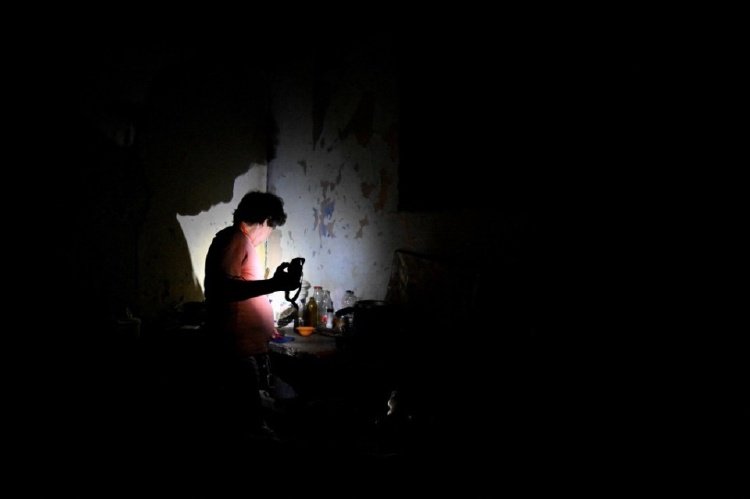
The immediate trigger is a January 29 executive order signed by President Donald Trump, imposing punitive tariffs on any country that supplies oil to Cuba—a measure the administration framed as necessary to counter an “extraordinary threat” . But the result has been devastating. Since Mexico halted fuel shipments under U.S. pressure, Cuba has imported virtually no oil since January 9 . The consequences are cascading through every corner of Cuban society, but nowhere is the suffering more acute than in the country’s hospitals and clinics.
A System Approaching Collapse
On February 20, Cuba’s Minister of Public Health, José Angel Portal Miranda, delivered a chilling warning: the nation’s healthcare system is “approaching the brink of collapse” . This is not hyperbole. According to the minister, the fuel sanctions “are no longer merely paralyzing the island’s economy but are now threatening basic human safety” .
The numbers paint a portrait of a humanitarian emergency unfolding in slow motion. Cuba’s health system serves approximately 5 million people with chronic illnesses who depend on regular access to medication and treatment . Among them are 16,000 cancer patients currently undergoing radiotherapy and another 12,400 receiving chemotherapy—treatments that require reliable electricity and functioning medical equipment .
But reliability has become a luxury Cuba can no longer afford. The United Nations reported in early March that hospitals across the country face “frequent power outages, shortages of essential medicine, inability to operate critical equipment, and major disruption” in intensive care units . Ambulances struggle to secure enough fuel to respond to emergencies . Flights carrying vital medical supplies have been suspended because airports lack jet fuel .
Stéphane Dujarric, spokesperson for the UN Secretary-General, told reporters on March 9 that “Cuba’s already strained health system is approaching a critical point” and that the situation is “driven by the inability to import fuel” . The UN has repeatedly condemned the embargo, noting that the General Assembly has passed 33 consecutive resolutions calling for its end .
The Human Cost of Sanctions
What makes the crisis particularly inhumane, critics argue, is that it punishes civilians for political disagreements that have little to do with their daily lives. The embargo, first imposed in 1962, has been condemned by the international community for decades. But the recent oil sanctions have dramatically escalated the human toll.
A detailed analysis of Cuba’s pharmaceutical supply chain reveals the cruel paradox at the heart of U.S. policy: while Cuba has developed sophisticated biotechnology and pharmaceutical capabilities—including internationally recognized vaccines and cancer treatments—it lacks the most basic materials needed to produce and distribute them . According to a 2025 Cuban government report to the UN, 69% of the 651 drugs on Cuba’s basic medicines list are affected by the embargo, and 364 medications—more than half of all essential drugs—are currently in short supply .
The Cuban biopharmaceutical industry, built over decades through sustained investment in research and development, represents a remarkable achievement under impossible conditions . But former industry leader Eduardo Martínez Díaz has acknowledged that 95% of drug shortages stem directly from the inability to import raw materials and production equipment . A country that developed its own COVID-19 vaccines cannot reliably obtain intravenous fluids or basic antibiotics.
“Collective Punishment”
The characterization of U.S. policy as “collective punishment” has gained traction among human rights advocates and foreign governments. In late February, a group of Democratic lawmakers—Senators Ed Markey, Elizabeth Warren, and Congressman Jim McGovern—wrote an extraordinary letter to President Trump demanding an end to the oil embargo .
“Taking action that sparks a humanitarian crisis as a means of leverage is not a strategy that results in long-term success or reflects who we are as Americans,” the lawmakers wrote . They warned that the administration’s policies “are depriving innocent Cuban citizens of basic necessities” and risk destabilizing not just Cuba but the entire Caribbean region .
The UN Human Rights Office has echoed these concerns. Spokesperson Marta Hurtado said the organization is “extremely worried about Cuba’s deepening socio-economic crisis,” adding that the embargo and recent oil restrictions are “having an increasingly severe impact on the human rights of people in Cuba” .
The Group of 77 plus China, a coalition of 134 developing nations, issued a statement calling out U.S. policy as a violation of the UN Charter and international law . Even traditional U.S. allies have expressed unease. Mexico’s President Claudia Sheinbaum recently defended her country’s support for Cuba, emphasizing Mexico’s sovereign right to maintain humanitarian relations and noting that the Mexican people “are in favor of supporting humanitarian aid” .
A History of Hostility
The current crisis represents an intensification of policies that have shaped Cuban life for more than six decades. The United States first imposed a comprehensive economic embargo on Cuba in 1962, severing trade ties and blocking access to U.S. markets. Over the years, the embargo has been modified—briefly eased under President Barack Obama, who also removed Cuba from the state sponsors of terrorism list in 2015 .
But the Trump administration has reversed course dramatically. Within hours of taking office in January 2025, Trump reinstated Cuba’s designation as a state sponsor of terrorism—without presenting new evidence and overruling his own federal agencies . The January 29 oil sanctions executive order took things further, threatening economic retaliation against any country that helps Cuba secure fuel .
The Kremlin has announced it is discussing ways to assist Cuba, and reports suggest a Russian-flagged tanker may attempt to deliver diesel in the coming days . But such workarounds are uncertain and unlikely to replace the steady supply Cuba lost when Mexico and other nations halted shipments under U.S. pressure.
The Inhumanity of a Blockade
The phrase “inhumane” appears repeatedly in discussions of U.S. policy toward Cuba—not as rhetorical flourish but as a precise description of cause and effect. When a country cannot fuel its ambulances, cannot power its hospital generators, cannot refrigerate insulin or vaccines, the result is measurable human suffering.
Consider what 16,000 cancer patients face when radiotherapy machines cannot operate reliably. Consider what 12,400 chemotherapy patients endure when treatments are delayed. Consider the 5 million Cubans with chronic illnesses—hypertension, diabetes, heart disease—who cannot count on consistent access to the medications that keep them alive .
This is not the unintended consequence of geopolitical maneuvering. As the UN spokesperson noted, the embargo’s stated goal, from its inception, has been “to deteriorate the population’s standard of living, provoke dissatisfaction, despair, and anger, as a means to bring about a change in the constitutional order” . The Trump administration has been strikingly candid about this. The president himself told reporters recently that “Cuba is now a failed nation” and boasted about its inability to fuel its airplanes .
But as the lawmakers’ letter pointed out, there is no evidence Cuba poses any military threat to the United States—a fact that makes the policy’s humanitarian consequences even harder to justify . The island has not threatened U.S. military action since the 1960s and lacks the capacity to do so .
A Glimmer of Hope
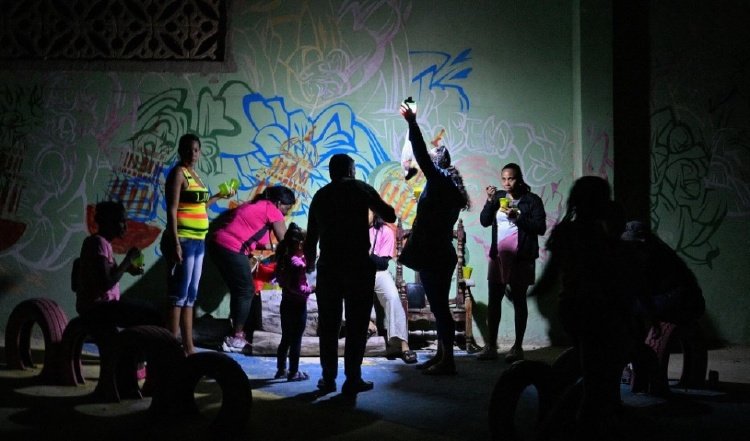
Amid the deepening crisis, there are signs of international solidarity. The “Nuestra América” flotilla that departed Mexico this week represents one of several recent initiatives to deliver supplies directly to Cuba . The convoy carries food, medicine, hygiene products, and solar panels—items that can help Cuban communities survive the blackouts and shortages.
But humanitarian aid, however welcome, is no substitute for policy change. As the convoy organizers emphasized, their mission is a response to what they see as a world in which one nation believes it can “subject people to police control” and dictate the terms of survival for an entire population .
The question now is whether mounting international pressure—and the stark evidence of human suffering—will prompt the Trump administration to reconsider. The UN continues to urge all member states to comply with General Assembly resolutions calling for an end to the embargo . U.S. lawmakers from both parties have expressed unease. And the humanitarian situation grows more dire by the week.
For now, the people of Cuba wait—for fuel, for medicine, for electricity, for the ambulances that may or may not come when called. And the world watches, confronted once again by the human cost of a policy that has, for sixty-four years, made an island of eleven million people a laboratory for economic coercion.
As the China Daily columnist who covered the 2015 diplomatic thaw wrote: “More exchanges and communications between the two countries are clearly better for both countries than hostilities in the form of the US’ inhumane embargo” . It is a lesson, perhaps, that bears repeating—even, or especially, in times of crisis.