
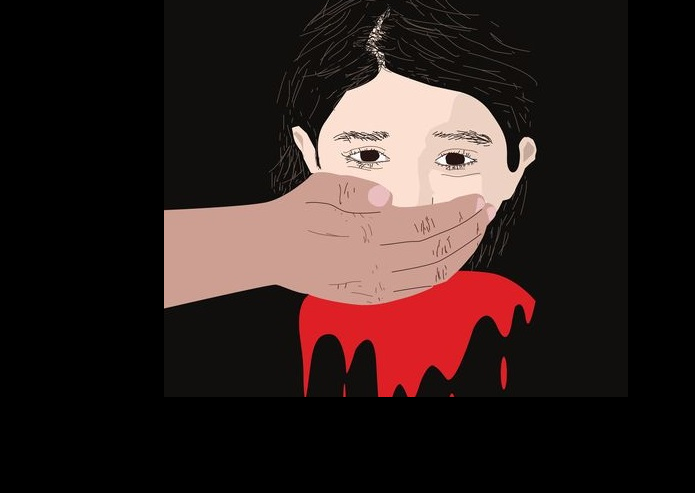

A tragedy painted as a teenage love story
When news broke of a missing 15-year-old girl discovered inside a remote cave in the Knuckles Mountain Range clutching her two-month-old infant, segments of Sri Lankan social media reacted with sickening romanticism. Commenters praised the 23-year-old man found with her for “not abandoning” the girl, framing the ordeal as a poignant “teenage love story.” That delusion collapsed when Ududumbara Police investigations revealed the grim, stomach-churning truth: the child had been repeatedly sexually abused since 2023—when she was just an eighth-grade student—by both the 23-year-old suspect and a 36-year-old man. Forced to give birth in a damp jungle cave without medical assistance, surrounded by venomous snakes, leopards, disease-carrying insects, and lethal germs, both the child-mother and her newborn were pushed to the edge of death.
The initial public impulse to romanticize statutory rape—before confronting the brutal reality of two adult predators exploiting a schoolgirl—exposes a rotting moral core within our society. As a nation, how sad should we be? Our grief should be bottomless, boundless, and furious, because the Knuckles tragedy is neither an isolated horror nor an aberration. It is a damning indictment of a systemic, multi-layered failure to protect Sri Lanka’s children.
“1,391 cases of statutory rape were recorded in 2022, followed by 1,259 cases in 2023, and 1,345 cases in 2024. When combined with non-consensual statutory rape and grave sexual abuse—which stood at 677 cases in 2022, 649 in 2023, and 571 in 2024”
Official data tells the scope of Child Abuse
While public outrage flares briefly around sensational headlines, official data reveals a relentless, daily catastrophe that we choose to ignore. According to Sri Lanka Police Grave Crime Abstracts, 1,391 cases of statutory rape were recorded in 2022, followed by 1,259 cases in 2023, and 1,345 cases in 2024. When combined with non-consensual statutory rape and grave sexual abuse—which stood at 677 cases in 2022, 649 in 2023, and 571 in 2024—the numbers are staggering. In 2024 alone, Sri Lanka Police recorded 1,916 cases of statutory rape and grave sexual abuse combined, translating to more than five children sexually violated every single day—a terrifying figure that still excludes hundreds of additional complaints of incest, sexual exploitation, and harassment logged by the National Child Protection Authority (NCPA). Between January and September 2025 alone, the NCPA recorded 7,773 child abuse and related complaints, including 192 cases of grave sexual abuse, 414 cases of sexual harassment, 49 cases of rape, 11 cases of incest, and 102 cases of cyberbullying involving the circulation of nude images of children.
“National data show that roughly 20% of teenage pregnancies occur among girls under the age of 17, while a recent 2025 study in Batticaloa published in *BMC Public Health* revealed that 11.2% of surveyed adolescent mothers became pregnant between the ages of 10 and 15”
The physical and psychological consequences of this unpunished carnage are etched permanently into the country’s maternal health records. While the Family Health Bureau (FHB) notes that registered teenage pregnancies (ages 10–19) declined nationally from 6.5% in 2009 to 3.8% in 2023, regional hotspots remain in an unmitigated crisis, with districts like Batticaloa (7.1% in 2023; 8.2% in 2020) and Trincomalee (7.5% in 2020) recording rates nearly double the national average. Crucially, national data show that roughly 20% of teenage pregnancies occur among girls under the age of 17, while a recent 2025 study in Batticaloa published in *BMC Public Health* revealed that 11.2% of surveyed adolescent mothers became pregnant between the ages of 10 and 15—meaning every single one of those pregnancies was the direct, undeniable result of statutory rape. Furthermore, the UNFPA highlights that girl in Sri Lanka report initiating romantic relationships as young as 11 or 12, with some experiencing their first sexual encounter between the ages of 10 and 14. Worst of all, every single statistic cited above represents only the fraction of cases that were actually reported, documented, and somehow survived public scrutiny. Given the suffocating weight of social stigma, family victim-blaming, and institutional intimidation, thousands more children are suffering in absolute silence behind closed doors.
Protection of Children: a non-negotiable duty of any civilized state.
Children are the living foundation of a nation’s moral, intellectual, and social survival. Protecting their physical integrity and psychological development is not a charitable afterthought or a bureaucratic inconvenience—it is the supreme, non-negotiable duty of any civilized state. Yet in Sri Lanka, there is no longer a single institution, sanctuary, or stratum of society where a child’s safety can be taken for granted. For generations, Sri Lankan society placed blind, unquestioning trust in educated, respected, and high-ranking figures across every pillar of authority—viewing them as infallible moral guardians. Today, court dockets, prison records, and police blotters across the island have shattered that illusion into dust, exposing a terrifying reality where predators wear the robes of the clergy, the suits of state officials, the uniforms of educators, and the respected mantles of community leaders.
A schoolgirl was gang-raped by multiple school students.
From the horrific 2015 gang rape and murder of 18-year-old schoolgirl Sivaloganathan Vithiya in Pungudutivu to the 2024 Thanamalwila tragedy—where a schoolgirl was gang-raped by multiple school students while video recording the crime—the schools meant to educate and nurture children have repeatedly turned into hunting grounds. The rot extends far beyond public classrooms; across the island, headlines continue to expose high-profile tuition masters exploiting students, elite sports coaches preying on young athletes, medical professionals violating patients, and orphanage directors abusing destitute wards of the state.
This predation penetrates the highest and most revered spiritual sanctuaries, unmasking religious figures across every faith who have weaponized their sacred authority and religious titles to groom, manipulate, and violate children. Judicial records confirm this pervasive betrayal across communities: in November 2026, the Court of Appeal upheld a 14-year prison sentence against a Buddhist monk convicted of sexually abusing an 11-year-old boy under his care inside temple lodgings; earlier in May and June 2026, Eragama Police arrested and remanded a 21-year-old acting as a Muslim Moulavi over the sexual abuse of a 14-year-old girl; and appellate rulings have similarly upheld a 10-year prison sentence for a Christian pastor convicted of raping a minor, alongside police arrests of clergy accused of molesting children inside church-run hostels. Even within the supposedly secure confines of the home, the judicial system reels under an endless wave of incest cases where fathers, grandfathers, uncles, and guardians—men sworn by nature and law to defend their own blood—transform family hearths into chambers of horror. From village alleyways to the most influential corridors of power, the very protectors across every segment of Sri Lankan society have become the predators.
Examining these horrors exposes a devastating set of common denominators that leave Sri Lankan children uniquely defenceless. First, children are routinely denied basic, age-appropriate knowledge of their own bodies, boundaries, and consent through the glaring absence of Comprehensive Sexuality Education (CSE), leaving many victims completely unaware that they are being sexually abused until severe trauma or pregnancy occurs. In Sri Lanka’s Magistrates’ Courts and High Courts, child witnesses frequently lack the anatomical vocabulary to describe what happened to them, forced to testify using crude, vulgar vernacular slang because no one ever taught them the proper names of their own body parts. Second, too many children grow up with spineless parents who refuse to listen or act. When a child musters the courage to report inappropriate touching or assault, families routinely dismiss it as a “misunderstanding,” laugh it off as a “joke,” or blame the child for “inviting” the attention—sending the victim straight back into the predator’s reach. Even when abuse is undeniable, countless parents lack the courage to confront influential community figures, choosing hollow social “honour” over their child’s justice. Third, when a child bypasses indifferent parents to seek help from a teacher, a religious leader, or a police officer, they are met with institutional disbelief, bureaucratic apathy, or further exploitation.
Sustained national conversation on child protection is a must
Is there a serious, sustained national conversation on child protection in Sri Lanka? The bitter answer is “no”. Public outrage in this country is strictly episodic—ignited by a horrifying headline, fuelled for a week of performative grief on social media, and conveniently forgotten until the next child is destroyed.
Right at the centre of this moral vacuum stand our successive, profoundly incompetent governments. How can we expect failing, visionless political regimes to build a robust framework for child safety when, for decades, they have been unable even to maintain a constant supply of cooking gas, electricity, rice, and petrol; the most basic survival needs of the population? While the rest of the world undergoes seismic technological shifts, leaps forward in artificial intelligence, and systematically re-engineers society to be fiercely child-friendly—enforcing mandatory background checks, strict safeguarding protocols, digital safety laws, and specialized child protection infrastructures—incompetent Sri Lanka still lag behind, perpetually paralyzed.
The context of failure
When a state is so chronically dysfunctional that it reduces its citizens to standing in endless fuel queues, it cannot and will not engage in profound, courageous policy reforms on child safety. Child protection has never been a priority for our political class. Instead, politicians, nationalist demagogues, and a complicit public perpetually wallow in the safe, lazy, and lucrative distractions of race, religion, and fabricated “threats” to them—screaming hysterically about the “need for protection” while remaining willfully blind to the real, bleeding threats destroying our children from within. This has been our national paralysis since independence. Worse still, powerful religious leaders actively and aggressively sabotage the introduction of Comprehensive Sexuality Education, deceiving the public under the guise of preserving “culture.” Why do they do it? To keep our children ignorant, to maintain oppressive control, and to shield the predators hiding in plain sight within our society. No political coalition, no religious congregation, and , c, no mass movement has ever mobilized in collective solidarity to save children the way they gather on command to prop up a corrupt political party, defend a fallen regime, or demand presidential pardons for convicted criminals.
How many more children must pay the price for everyone to open their eyes, exit their cryo-sleep, and act? If we delay any further, we forfeit our right to call ourselves a civilized society, and we will have no choice left but to weep as a nation. To stop this carnage, we must demand immediate, uncompromised, radical action. First, we must mandate Comprehensive Sexuality Education by stripping religious extremism and political cowardice out of the education ministry, enforcing standardized, science-based education on bodily autonomy, consent, and reproductive health across every school curriculum, backed by mandatory teacher training. Secondly, we must enact uncompromising legal reforms and programmes, establishing a uniform, non-negotiable minimum marriage age of 18 across all communities without exception, and rehabilitation of victims of statutory rape and incest cases, so that child victims are in safe hands. Thirdly, we must shatter institutional silence by passing draconian mandatory-reporting laws that criminalize any doctor, teacher, principal, police officer, or religious clergy member who conceals or fails to report child abuse, paired with a permanent public sex offender registry. Similarly, we must guarantee school reintegration and safe shelters by enforcing zero-tolerance rules forcing schools to readmit pregnant minors and young mothers without stigma, and building state-funded safe homes, hostels, and psychological rehabilitation centres in every province to rescue children trapped in abusive environments.
If we continue to let incompetent governments deprioritize our children while we argue over hollow politics, we are not merely failing the next generation—we are actively sentencing them to slaughter.
Image from the Internet. (Niroshan Pathberiya is an Attorney at Law)