

BY A Jathindra
“In China, there is one Party in power, which has its advantages. It allows them to work towards one plan and policy. If we in Sri Lanka start making changes now but lose power in five years, everything that we began could be undone by the next Government. To achieve real change, we need at least 15 to 20 years, perhaps even four consecutive Election victories, in order to follow through on a single vision,” Silva explained.
According to Silva, “We were a Party building towards power; now we are a Party in power. That means that our members must learn new ways of thinking, managing the economy, and governing effectively.”
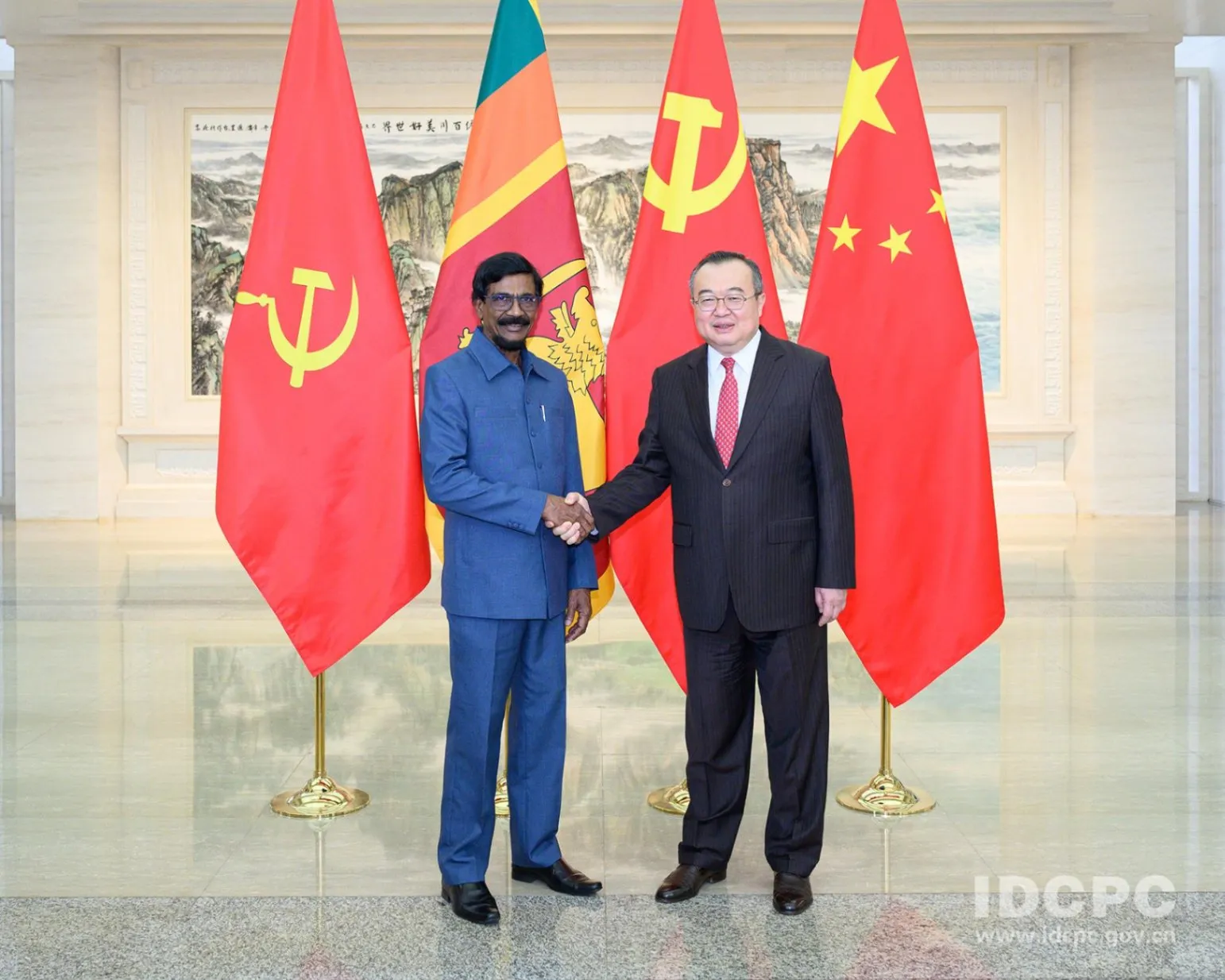
Silva led a delegation to China at the invitation of the Chinese Communist Party (CCP), travelling across several Provinces and meeting senior Party leaders. Among them were a member of the Political Bureau of the CCP Central Committee (CC) and of the CCP CC’s Organisation Department Head Shi Taifeng, and of the International Department of the CCP CC Minister Liu Jianchao. Jianchao reportedly assured the delegation that no one would be allowed to undermine Party-to-Party relations between the CCP and the JVP.
Against this backdrop, another CCP delegation is expected to visit Sri Lanka to share its experience in Party organisation and discipline. Silva disclosed this following a meeting with Chinese Ambassador to Sri Lanka Wei Huaxiang at the JVP Headquarters in Pelawatte, Colombo. Huaxiang briefed JVP leaders on the Fifth Plenary Session of the 20th CC of the CCP, held in Beijing from 26 to 29 October, which adopted a resolution on strengthening comprehensive and rigorous Party self-governance.
Brazilian academic and Associate Professor of International Relations at the Pontifical Catholic University of Minas Gerais, Javier Vadell interprets the resolution through the lens of Antonio Francesco Gramsci’s concept of the “modern prince” – a political party that functions as a collective organism capable of shaping popular will and leading the intellectual and moral transformation of society.
The JVP’s evolving political relationship with China
The JVP’s historical trajectory is well known. Anti-Indian and anti-American rhetoric featured prominently throughout much of its evolution from an insurgent movement into a mainstream political Party. The Party’s founder, Patabendi Don Jinadasa Nandasiri Rohana Wijeweera, was heavily influenced by the Chinese interpretation of communism.
When the Communist Party of Sri Lanka split over ideological differences, Wijeweera aligned himself with the Peking Wing because of his admiration for Mao Zedong’s ideology. This alignment helped nurture a narrative portraying India as an “expansionist power”, a theme that later became one of the JVP’s core ideological teachings.
However, the origins of this anti-India narrative can largely be traced to the Sri Lankan Tamil Marxist leader from Jaffna who led the Peking Wing, Nagalingam Shanmugathasan. Shanmugathasan was among the few South Asian communist leaders to have met Zedong personally.
According to one account, Shanmugathasan was highly critical of Tamil militant groups such as the Eelam People’s Revolutionary Liberation Front that collaborated with the Indian Peace Keeping Force (IPKF) during the IPKF-Liberation Tigers of Tamil Eelam conflict, regarding them as agents of Indian expansionism.
This suggests that Shanmugathasan’s political worldview may have influenced Wijeweera’s perception of India. Yet, it is equally important to recognise that Shanmugathasan himself did not endorse the JVP’s political methods or its insurrectionary strategy. According to accounts attributed to Shanmugathasan, he believed that the JVP often employed anti-India rhetoric on a communal and nationalist basis rather than from a principled Marxist (Karl Marx) standpoint.
Although the JVP continues to employ Marxist-Leninist (Vladimir Lenin) rhetoric, its political roots remain deeply intertwined with Sinhala nationalism. In this respect, it is not unique. Both Southern and Northern politics in Sri Lanka have long been shaped by competing forms of nationalism, which continue to serve as powerful instruments of political mobilisation, often deployed by political actors to advance their own interests and consolidate support.
However, the JVP-led National People’s Power (NPP) Government largely avoided relying on nationalist rhetoric to secure victory in the recent Presidential and Parliamentary Elections. Since coming to power, the Party has made a visible effort to distance itself from aspects of its past political behaviour and ideological image while attempting to project a more modern and pragmatic identity both domestically and internationally. Yet, its deepening engagement with the CCP raises important questions about the political lessons that it hopes to draw from China’s experience.
Against this backdrop, a fundamental question arises: Why does the JVP continue to attach such importance to maintaining close Party-to-Party ties with the CCP?
The China model and its approach to political governance
Indeed, what can the JVP learn from a one-Party State? Is it inspired by the Party-State model established by the CCP? Or, is it primarily interested in understanding China’s system of political meritocracy?
For decades, the limitations of electoral democracy have been debated by political theorists and intellectuals. Within these discussions, the so-called “China model” has emerged as an alternative approach to governance. In his 2015 book, The China Model: Political Meritocracy and the Limits of Democracy, Canadian political theorist Daniel A Bell, who taught in China for many years, argued that contemporary Chinese politics is increasingly characterised by a system of political meritocracy that may address some of democracy’s enduring weaknesses. Bell described the “China model” as a system that combines meritocracy at the top, experimentation in the middle, and democracy at the grassroots level.
Bell’s argument, however, has attracted substantial criticism and continues to do so. Political scientist Andrew James Nathan argued that “The China Model is not an account of the real China. Just as Western thinkers for centuries have constructed images of China to wield as weapons in their polemics with one another, so too does Bell present an imaginary China.”
Critics further argue that Chinese President Xi Jinping’s China increasingly exhibits authoritarian characteristics that challenge the notion of China as a meritocratic political system. Chinese economist and political strategist, Chris Leung Lee argues that the authoritarian model consolidated under Jinping’s leadership is exhibiting growing structural weaknesses. Its most significant flaw, he contends, lies in the unconstrained power of the ruling CCP, which can intervene arbitrarily in economic and social affairs without robust mechanisms for accountability or institutional self-correction.
Lee further argues that, internationally, the “China model” has become more combative, assertive, and expansionist. In his view, the CCP increasingly seeks to reshape the international order. He contends that China’s rise was not primarily the result of the so-called “China model”. Rather, excessive Party intervention can distort normal social and economic behaviour, create uncertainty for investment and consumption, weaken public confidence, and undermine both domestic and international perceptions of China’s long-term stability.
Given this background, an important question remains: What exactly is the JVP seeking to learn from the CCP? Is the Party merely studying organisational discipline and long-term political planning, or, does it see value in elements of a system often associated by critics with one-Party dominance, centralised political control, and authoritarian governance? The answer may offer important clues about the future direction of both the JVP and Sri Lanka’s evolving political landscape.
What the JVP hopes to learn from China’s experience
Yet, there is a striking contradiction. The Government frequently presents its anti-corruption agenda as one of its defining missions, and the JVP appears particularly interested in the CCP’s disciplinary mechanisms and Party governance structures. However, Sri Lanka’s previous administrations pursued similar engagements with China. During the era of President Percy Mahendra Mahinda Rajapaksa, which the NPP regularly portrays as a period marked by widespread corruption and mismanagement, Colombo also sought to learn from China’s governance experience.
President Nandasena Gotabaya Rajapaksa himself told Jinping that Sri Lanka hoped to learn from the governance experience of the CCP, particularly in areas such as poverty alleviation and rural development. This raises an uncomfortable question: If successive Sri Lankan Governments, despite their vastly different political identities, have looked to the CCP for lessons in governance, what tangible outcomes have such exchanges produced?
The question becomes even more relevant given that the Fifth Plenary Session placed significant emphasis on strengthening Party discipline and combating corruption. If these principles have long been central to the CCP’s political doctrine, what lessons were previously shared with Sri Lanka’s ruling elites, and why did they fail to prevent the governance-related failures and corruption allegations that later became defining features of successive administrations? More importantly, if previous Sri Lankan Governments failed to translate such engagements into better governance, what does the JVP believe it can achieve through its relationship with the CCP that its predecessors could not?
Original Caption: Is the JVP seeking to build a ‘modern prince’ for SL?
The writer is a political analyst and the founding Director of the think tank based in Trincomalee, the Trinco Centre for Strategic Studies
(Courtesy of The Morning)