
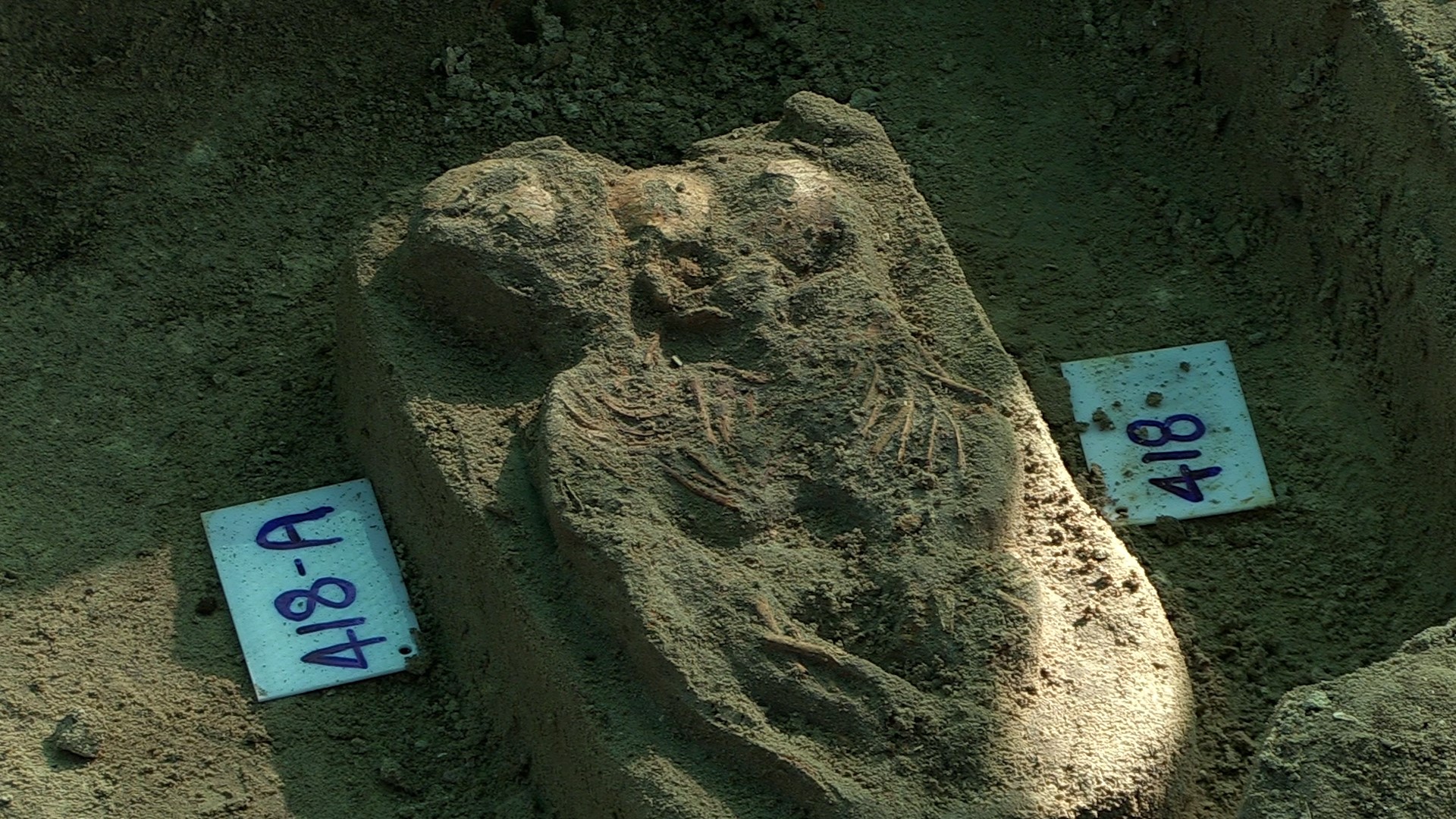

Jaffna – Growing controversy has erupted over the ongoing investigation into the Chemmani mass grave in Jaffna after Tamil political parties strongly challenged suggestions in an interim archaeological report that the hundreds of human remains unearthed at the site could be linked to a natural disaster or epidemic.
The Democratic Tamil National Alliance (DTNA) and the Eelam People’s Democratic Party (EPDP) have separately called for an independent and credible investigation, warning that premature conclusions could undermine efforts to establish the truth about one of Sri Lanka’s largest suspected mass grave sites.
The debate follows the submission of an interim report to the Jaffna Magistrate’s Court by Chief Archaeologist Professor Raj Somadeva and archaeologist Anusha Wanninayake. According to reports, the document raised the possibility that at least some of the burials could be connected to a historical epidemic or natural catastrophe, prompting sharp criticism from Tamil representatives and families seeking answers about wartime disappearances.
Discovery Revives Longstanding Questions
The Chemmani site came under renewed scrutiny after construction workers uncovered skeletal remains at Sindhupathi in Jaffna, leading to court-ordered excavations. Over more than 110 days of excavation work conducted in 2025 and 2026, archaeologists recovered 583 human skeletons, making it one of the most significant grave sites discovered in Sri Lanka in recent decades.
The latest discovery has revived painful memories of allegations dating back to the late 1990s, when former soldier Somarathna Rajapaksa, convicted in the rape and murder of schoolgirl Krishanthi Kumaraswamy, claimed that hundreds of bodies had been secretly buried in the Chemmani area. His testimony became one of the earliest public allegations linking the site to wartime killings and enforced disappearances.
Although limited excavations were conducted in 1999 following those revelations, victims’ groups and human rights advocates have long argued that investigations were incomplete and failed to pursue leads that could have identified the fate of missing persons.
Calls for International Involvement
DTNA spokesperson Suresh Premachandran said the scale of the discovery, combined with Sri Lanka’s history of unresolved disappearances, requires an international investigation.
He argued that the remains should be examined against records of wartime killings, disappearances, detention operations and civilian casualties in the North. Premachandran also pointed to reports that some skeletons may show evidence of gunshot injuries and sharp-force trauma, findings which, if confirmed through forensic analysis, could challenge suggestions that the burials resulted solely from disease or natural causes.
Sri Lanka’s civil war, which lasted nearly three decades, left thousands of people missing. Various commissions of inquiry, including the Lessons Learnt and Reconciliation Commission, the Paranagama Commission and the Office on Missing Persons, received complaints relating to tens of thousands of disappearances. Human rights organisations have repeatedly identified enforced disappearance as one of the country’s most serious unresolved legacies.
Premachandran accused successive governments of failing to adequately investigate allegations related to Chemmani and expressed disappointment that the current administration had not moved more decisively to ensure an independent inquiry.
EPDP Urges Presidential Oversight
In a notable development, the EPDP, which has often occupied a different political space from Tamil nationalist parties, also expressed concern about attempts to explain the burials before forensic investigations are completed.
Addressing journalists in Jaffna, EPDP Media Secretary Srikanth Panneerselvam urged President Anura Kumara Dissanayake to personally oversee the investigation and ensure that all possible explanations are rigorously examined.
Panneerselvam questioned whether an epidemic or natural disaster could realistically account for such a large number of deaths, noting that residents who lived in the region during the 1970s, 1980s and 1990s do not recall any disaster or disease outbreak that caused fatalities on that scale.
He further argued that even if some remains were found to be centuries old, it would be premature to assume that all recovered remains originated from the same historical period. Scientific dating and forensic analysis, he said, are essential before any definitive conclusions can be reached.
Wider Significance
The Chemmani excavations have become a test case for Sri Lanka’s ability to investigate atrocity allegations through credible forensic and judicial processes.
Human rights groups have long argued that previous mass grave investigations, including those at Chemmani, Mannar, Sathurukondan and other sites, were hampered by delays, political interference, inadequate forensic resources and the absence of witness-protection guarantees.
Observers note that the eventual significance of the Chemmani findings will depend not only on archaeological assessments but also on comprehensive forensic examinations, including carbon dating, DNA profiling, anthropological analysis and investigations into possible causes of death.
For families of the disappeared, the discovery represents a rare opportunity to uncover the fate of missing relatives and obtain long-awaited answers after decades of uncertainty.
Both the DTNA and the EPDP have stressed that only a transparent, scientifically grounded and independent investigation can establish the true circumstances surrounding the burials and ensure public confidence in the outcome.