
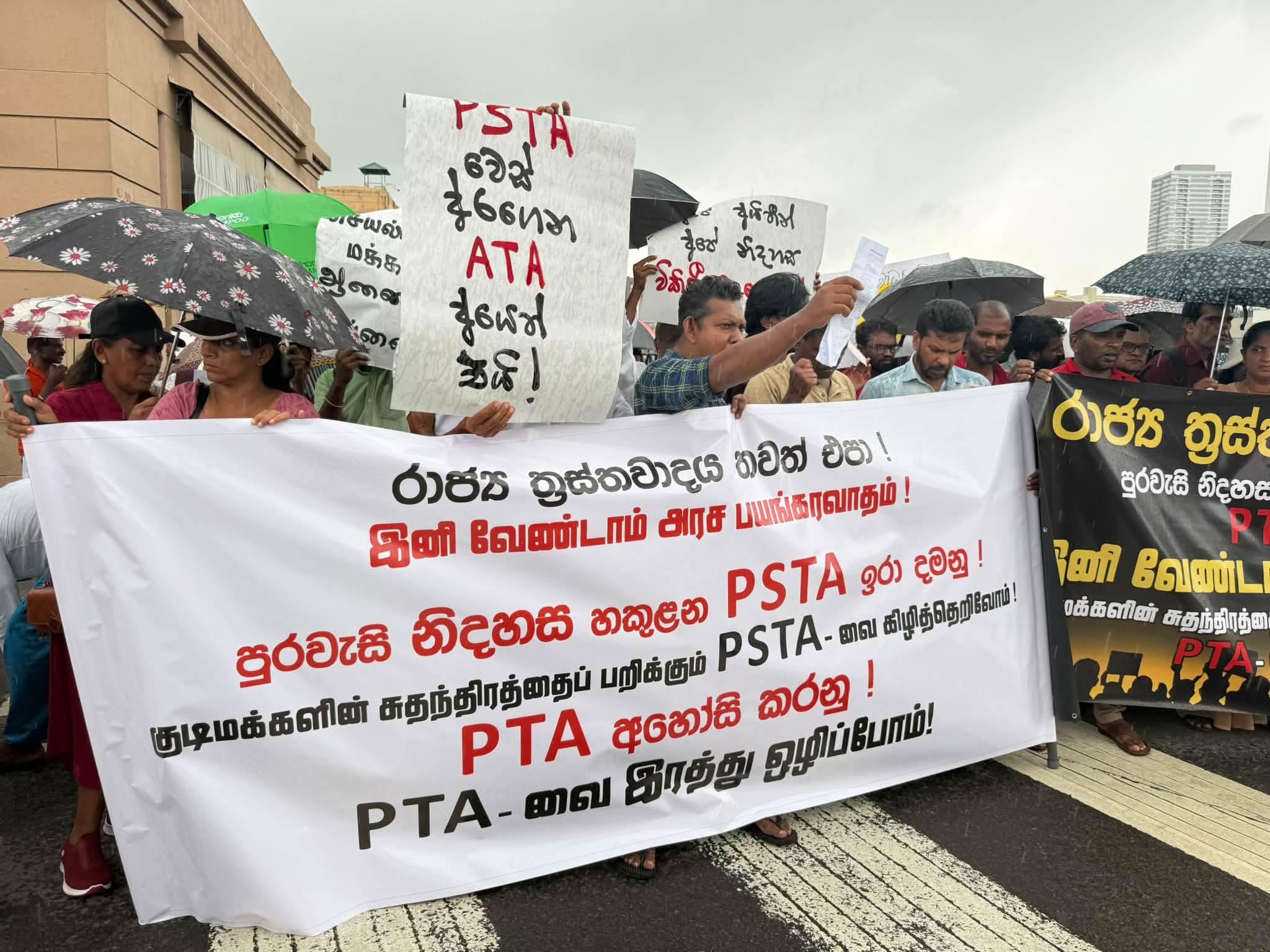

Image: On the same day, OHCHR issued its recommendations civil society staged a protest in front of the Presidential Secretariat
Geneva/Colombo, 13 October 2026 – The UN Office of the High Commissioner for Human Rights (OHCHR) has called on the Sri Lankan Government to substantially revise its proposed Protection of the State from Terrorism (PSTA) Bill, warning that key provisions risk perpetuating many of the human rights concerns long associated with the Prevention of Terrorism Act (PTA).
In a detailed legal assessment released on 13 October, OHCHR acknowledged that the latest version of the Bill contains several improvements over earlier drafts, including a narrower definition of terrorism, the removal of police confessions as admissible evidence, stronger safeguards for journalists and civil society actors, mandatory audio-visual recording of police interviews, and the establishment of a central database of arrests and detentions.
However, the UN rights body concluded that the proposed law continues to grant sweeping powers to the executive and security forces while failing to provide sufficient judicial oversight, due process guarantees, and protection against torture and arbitrary detention.
Among its key recommendations, OHCHR urged the Government to narrow and clarify the definition of terrorism; require prompt and effective judicial control over every arrest and detention; strengthen safeguards against torture, ill-treatment and enforced disappearances; reinforce fair trial protections; and make judicial warrants mandatory for searches, seizures and other intrusive powers.
The UN body also called for the removal of broad law enforcement powers granted to the armed forces, insisting that civilian police should retain primacy in counter-terrorism operations and that any military involvement should remain exceptional and subject to strict civilian oversight.
OHCHR further recommended the creation of robust mechanisms for independent oversight, accountability and remedies for victims of rights violations. It stressed that immunity provisions should not protect officials responsible for unlawful arrests, torture, enforced disappearances or other serious abuses.
Another significant recommendation concerns the Bill’s transitional provisions. OHCHR urged Sri Lanka to review all cases, detentions, prosecutions and restrictions carried forward from the PTA to ensure compliance with international human rights standards, including legality, necessity, proportionality and fair trial guarantees.
The UN rights office also appealed for a transparent and inclusive consultation process involving civil society organisations, legal professionals, independent institutions and affected communities before any further legislative action is taken.
Concluding its assessment, OHCHR reiterated its willingness to provide technical assistance to Sri Lanka in developing counter-terrorism legislation that meets international human rights standards while addressing legitimate security concerns.
OHCHR statement: ohchr-comments-pstabill-14-10-26