

The climat emergency can some times feel like a distant conversation taking place on international conference circuit. Yet its consequences are felt in villages across Sri Lanka.
Communities are experiencing longer droughts, heavier rainfall, floods, landslides and rising temperatures. Farmers are struggling with changing weather patterns. Water resources are becoming less predictable. Forests continue to shrink. Wildlife is losing its habitat.
The recent impacts of Cyclone Dithva reminded us that climate change is no longer a future threat. It is disrupting lives today.
Recognising this global crisis, countries around the world adopted the Paris Agreement, committing themselves to reducing greenhouse gas emissions and limiting global warming to 1.5°C. Through the 2030 Sustainable Development Goals, governments also committed themselves to protecting biodiversity, restoring ecosystems and ensuring that no one is left behind as societies respond to climate change.
These commitments cannot remain words on paper.
They must be reflected in the choices we make in our homes, schools, villages and communities.
The Elephant-Free Elephant Walk is one example of what local climate action can look like.
Why elephants?
The elephant is much more than the symbol of this walk, elephants tell the story of the health of our forests.
Healthy forests absorb carbon dioxide, cool our climate, protect rivers, support agriculture and provide homes for thousands of species. When forests disappear, the consequences extend far beyond wildlife. Communities lose water security, biodiversity declines and climate change accelerates.
As forests shrink, elephants increasingly enter villages and agricultural lands in search of food and water, intensifying human-elephant conflict. In late July 2026 five elephants were reported in the Peddawa area in the Ibbagamuwa Division of the Kurunegala District. They had traversed coconut estates and villages in their quest for water.
Recent data obtained by The Grassrooted Trust from the Department of Wildlife Conservation highlights the urgency of restoring this balance. Between 2023 and 2025, 631 elephants were killed through direct human activities, including gunshots, electrocution, poisoning and hakka patas. During the same period, 499 people also lost their lives as a result of human-elephant conflict.
These figures are more than statistics.
They reveal a landscape where forests are disappearing, ecosystems are becoming fragmented and both people and wildlife are paying the price.
Protecting elephants therefore means protecting forests.
Protecting forests means protecting our climate.
Why are women walking?
Climate change affects everyone, but it does not affect everyone equally.
Across Sri Lanka, women are often the first to experience the consequences of climate-related disasters. When harvests fail, it is women who stretch household meals further. When water becomes scarce, it is women who travel further to collect it. When disasters strike, women take on greater responsibility for caring for children, older people and those who are sick, often while rebuilding livelihoods of their own.
Children also bear a heavy burden. They inherit the consequences of decisions they did not make, yet they have the least power to influence those decisions.
For this reason, women from Athwela Women Circles in Ibbagamuwa will walk beside children, calling for climate solutions that recognise women’s leadership, strengthen food security, protect public health and place communities at the centre of climate action.
There can be no climate justice without gender justice.
Children leading change
In the months leading up to the walk, Athwela Partnership conducted climate awareness sessions in six participating schools from the Ibbagamuwa Education Division.
Students explored how climate change, biodiversity loss, plastic pollution, human health and sustainable living are interconnected.
On 23 August, those lessons will come alive.
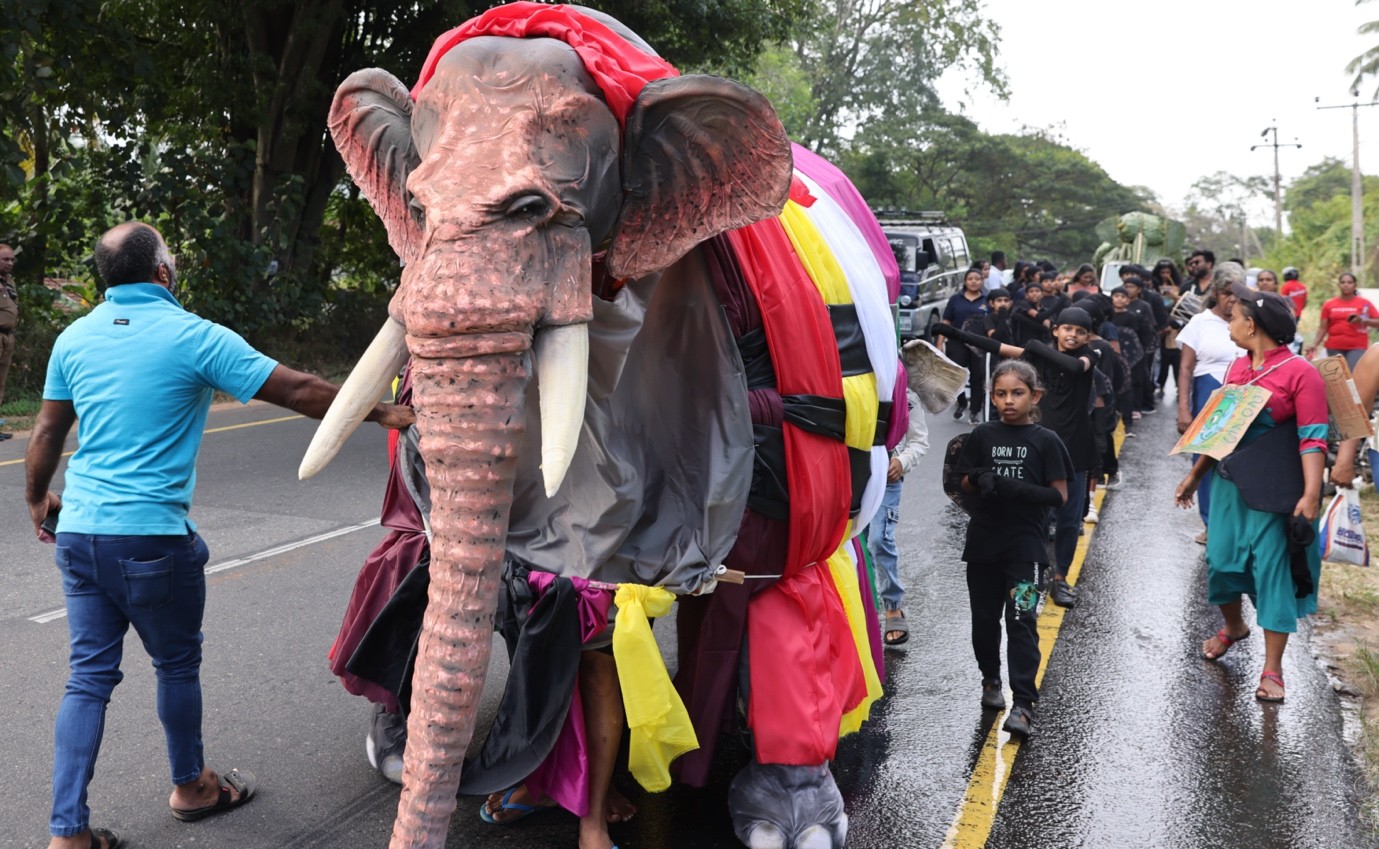
The walk will feature giant elephant puppets built by students, powerful theatre performances on the climate emergency, traditional dance celebrating tree planting and ecosystem restoration, children wearing costumes created from discarded plastic waste, bicycles transformed into elephants, six three-wheelers decorated with plastic waste and two built using recycled plastic bottles.
The event will conclude with a Zero Waste Food Fair, demonstrating that sustainable living is not simply an idea, it is something communities can practice every day.
Walking together
The Elephant-Free Elephant Walk is more than an event.
It is a reminder that climate action begins in communities.
It begins when children ask difficult questions.
It begins when women refuse to accept that environmental destruction is inevitable.
It begins when communities choose creativity over despair and action over silence.
Every step taken on 23 August is a step towards restoring the balance between people and nature, honouring our commitments to future generations and recognising that climate justice, biodiversity conservation and gender equality are inseparable.
On 23 August, the children and women of Ibbagamuwa invite everyone to walk with them.
Not simply to witness an event.
But to become part of a movement.
Event Details
- Event: Second Elephant-Free Elephant Walk
- Date: Saturday, 23 August 2026
- Time: 3.00 p.m.
- Starting Point: Ibbagamuwa Central College
- Ending Point: Devasarana Development Centre, Yakalla Junction
Highlights
- Climate Action Walk led by children and women
- Student performances
- Giant elephant puppets
- Athwela Creative Club bicycle parade
- Three-wheeler elephants festooned with plastic waste
- Zero Waste Food Fair and Prize giving ceremony
Organised by Athwela Partnership
- The Grassrooted Trust
- Devasarana Development Centre
- Women’s Development Foundation
- Nigel Billimoria Elephant Conservation Trust
Media Contact
Telephone/WhatsApp: +94 76 361 3112
Email: [email protected]