

Sri Lanka’s public sentiment reveals a nation navigating economic pressure, evolving political expectations, and shifting confidence in its leaders. Recent survey findings of CPA/Social Indicator show that many households continue to struggle financially, even as opinions on governance, institutional reform, and disaster recovery vary significantly across communities, age groups, and regions. While support for abolishing the Executive Presidency remains strong, views on the urgency of reform are more tempered. At the same time, public satisfaction with the current President and the NPP’s governance capacity stands notably higher than perceptions of the Opposition Leader. These insights collectively illustrate a complex but revealing picture of how Sri Lankans assess their economic realities, political priorities, and the performance of national leadership.
Key findings of the research:
Public Perception on Household Economic Situation
Overall, a majority of Sri Lankans (51.4%) reported that their household economic situation has worsened compared to a year ago, while 30.3% felt it has remained the same. Only 18.2% stated that their household economy has improved, indicating that many households continue to experience economic difficulties.
Satisfaction with the Government’s Management of the Cost Of Living
On a national level, public perception of the government’s handling of cost of living is almost evenly divided: 45.3% of respondents are satisfied, while a similar proportion (44.0%) is dissatisfied.
Dissatisfaction is highest among the Sinhala community (48.4%), while satisfaction is notably high among the Malaiyaha Tamil (66.7%) and Tamil (60.0%) communities. Younger respondents report higher satisfaction (50.8%) than those above 30 years (42.4%), while satisfaction is markedly lower in urban areas (34.8%) compared to rural areas (46.6%).
Public Opinion on the Abolition of the Executive Presidency
A majority of Sri Lankans (64.1%) support the abolition of the Executive Presidency, although only 23.6% believe the process should begin immediately. The largest share (40.5%) supports abolition but does not consider it an immediate priority, while 23.0% oppose the abolition of the Executive Presidency.
Support for immediate abolition is highest among Tamil respondents (41.4%), while Sinhala respondents more often support abolition without treating it as an immediate priority (43.4%). Opposition is also high among the Sinhala community (25.1%). Male respondents are more likely to strongly support immediate abolition (28.4%) compared to female respondents (18.9%), while urban respondents are more likely to back immediate abolition (31.4%) than rural respondents (22.7%).
Public Satisfaction with the President and Opposition Leader
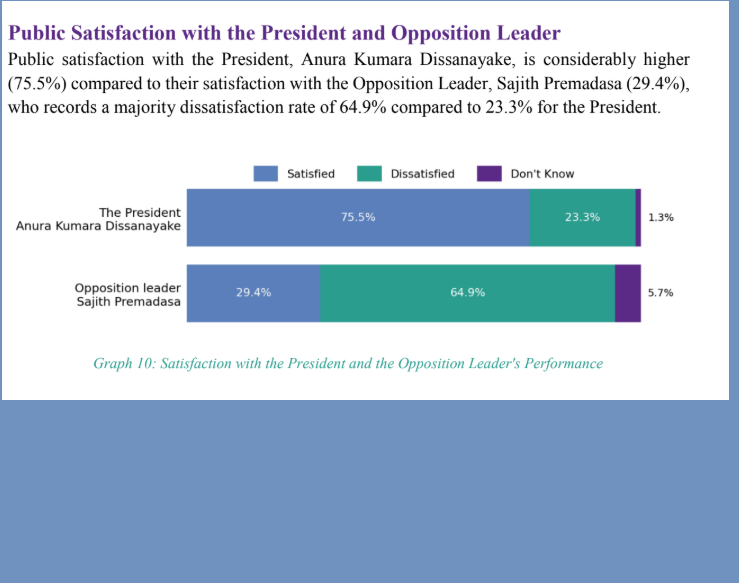
Public satisfaction with the President, Anura Kumara Dissanayake, is considerably higher (75.5%) compared to their satisfaction with the Opposition Leader, Sajith Premadasa (29.4%), who records a majority dissatisfaction rate of 64.9% compared to 23.3% for the President.
Public satisfaction with the President is highest among the Malaiyaha Tamil (94.4%) and the Muslim (93.4%) communities, while it is lowest among the Sinhala community – though still a majority (69.9%). Satisfaction with the President is also highest among 18–29-year-olds (81.6%) and rural residents (76.4%), while satisfaction with the Opposition Leader remains comparatively low across all groups.
Satisfaction with the NPP’s Capacity to Deliver Efficient Governance
A majority of Sri Lankans (62.8%) are satisfied with the NPP’s capacity to deliver efficient governance, while 23.1% are dissatisfied. 8.8% of Sri Lankans are neither satisfied nor dissatisfied.
Satisfaction is markedly higher among the Tamil (80.7%), Malaiyaha Tamil (79.6%), and Muslim (76.9%) communities compared to the Sinhala community (57.3%), which also reports the highest dissatisfaction (26.5%). Younger respondents report markedly higher satisfaction (71.3%) than those above 30 years (58.2%), and satisfaction is somewhat higher in rural areas (63.5%) than urban areas (57.1%).
Satisfaction with the Government’s Progress on Ditwah Disaster Relief, Recovery and Rebuilding
A majority of Sri Lankans (68.6%) are satisfied with the government’s progress on disasterrelief, recovery, and rebuilding following the Ditwah disaster, while 22.1% are dissatisfied.
Satisfaction is markedly higher among the Malaiyaha Tamil (84.9%), Tamil (81.3%), and Muslim (77.9%) communities compared to the Sinhala community (64.7%), which also reports the highest dissatisfaction (25.0%). Younger respondents report relatively higher satisfaction (72.4%) than those above 30 years (66.5%), while satisfaction is marginally higher in rural areas (68.9%) than urban areas (65.7%).
Satisfaction with Government Progress on Easter Sunday Attack Investigations
Just over half of Sri Lankans (51.6%) are satisfied with the government’s progress in investigating and holding accountable those responsible for the Easter Sunday attack, while 32.4% are dissatisfied.
Importance of Holding Provincial Council Elections
A majority of Sri Lankans (67.0%) consider that it is important to hold Provincial Council Elections, while 20.3% do not consider it important.
Views on the importance of holding Provincial Council Elections are broadly similar across all four ethnic groups, ranging from 63.4% to 70.4%. Younger respondents are more likely to consider these elections important (71.0%) compared to those above 30 years (64.9%), with views remaining broadly similar between male and female respondents and between urban and rural respondents.
Public Satisfaction with the President and Opposition Leader
Public satisfaction with the President, Anura Kumara Dissanayake, is considerably higher (75.5%) compared to their satisfaction with the Opposition Leader, Sajith Premadasa (29.4%), who records a majority dissatisfaction rate of 64.9% compared to 23.3% for the President.
Compiled from a social research report published by the CPA, Colombo, Sri Lanka.
The Centre for Policy Alternatives (CPA) is an independent, non-partisan organization that focuses primarily on issues of governance and conflict resolution. Formed in 1996 in the firm belief that civil society’s vital contribution to the public policy debate requires strengthening, CPA is committed to programmes of research and advocacy through which public policy is critiqued, alternatives identified and disseminated.