
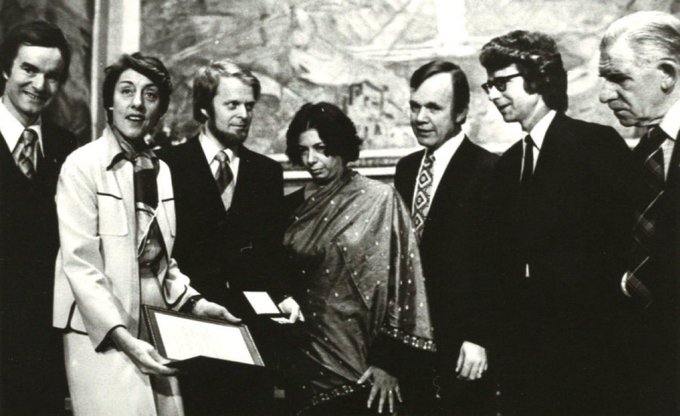

Image: Suriya Wickremasinghe is seen (4th from the left) as a member of Amnesty International’s Executive Committee accepting the Nobel Peace Prize in 1977. (Courtesy of Amnesty International X post)
Lionel Bopage.
Sri Lanka has lost one of its most courageous and enduring voices for human rights and social justice. Suriya Wickramasinghe, Secretary of the Civil Rights Movement of Sri Lanka (CRM), former Chair of the International Executive Committee of Amnesty International, a courageous activist who stood up for political prisoners and a silent but unwavering advocate for the disenfranchised, has left a long-standing void across the country with her passing. She brought to her work a rare combination of legal precision, moral clarity, and personal courage, sustained over more than five decades of public life.
A Family Forged in Struggle
Suriya was born into one of Sri Lanka’s most remarkable progressive households. Her father, Comrade Dr. S.A. Wickremasinghe, my political visionary at the time, was the founder and a pivotal leader of the Communist Party of Sri Lanka (formerly the Communist Party of Ceylon) that was established in 1943. Her mother, Doreen Young Wickremasinghe — a British-born socialist who came to Sri Lanka in the 1930s. Later, she became a Member of Parliament of the Communist Party of Ceylon and was the first President of the “Suriya Mal Movement,” which sold the golden Suriya flower to raise funds for local causes rather than for British war veterans. That campaign gave Suriya her name — one that came to stand for resistance and compassion. Doreen was conferred the title of Deshamanya, Sri Lanka’s second-highest civil honour, in 1998. Her brother Suren was a distinguished architect. Suriya carried this legacy forward with tenacity, translating her parents’ idealism into decades of practical human rights work.
The Civil Rights Movement: A Shield for the Vulnerable
As the long-standing Secretary of the CRM, Suriya shaped the organisation into one of Sri Lanka’s most principled civil society voices. Through insurgency, civil war, emergency rule and political upheaval, she stood as what one legal scholar described as “a fearless fighter against the excesses of emergency rule.” Under her leadership, the CRM was among the first to argue that human rights protection and monitoring must be a foundational, non-negotiable component of any peace settlement: “It has always been the firm conviction of the CRM that the proper securing of human rights throughout Sri Lanka, both in law and as a practical reality, must be an integral part of any political settlement of the conflict.” She documented state violence, published detailed reports on the human rights situation during periods of conflict. She was recognised internationally as one of the “100 Unseen Powerful Women” by One World Action for her impact on global rights culture.
Amnesty International and the Release of Political Prisoners
From 1982 to 1985, Suriya served as Chairperson of the International Executive Committee of Amnesty International, placing her at the centre of the worldwide campaign for prisoners of conscience. Her work with Amnesty was deeply connected to the aftermath of the April 1971 uprising. Then thousands of youngsters were murdered under the Emergency Law, and tens of thousands of young Sri Lankans were imprisoned under the Emergency Law and the Criminal Justice Commission (CJC) Act. In the early 1970s, Suriya appeared before the Criminal Justice Commission alongside the eminent legal counsel Mr. S. Nadesan and Mr. Guruswamy, representing Mr. Susil Siriwardena and Mr. Viraj Fernando — a brave act at a time when association with the accused was itself politically fraught.
In 1975, together with Ms. Yvonne Terlingen of Amnesty International, Suriya visited comrade Rohana Wijeweera at the New Magazine Prison in Colombo. Rohana requested Yvonne to carry their appeal to Amnesty International to intensify the campaign for political prisoners — a campaign the CRM was already waging. Wijeweera later recalled that they listened with genuine care and attentiveness. As a person that was incarcerated at the time, I later wrote: “We were convinced that Amnesty International and the Civil Rights Movement were genuine in their campaign for the release of political prisoners, and we were grateful to them.”
Against the Gallows
Suriya’s sustained campaign against the death penalty was among the most powerful expressions of her moral conviction. Writing in Pravada, she argued that resuming judicial hangings in Sri Lanka would be “a retrograde step in the progress of our country.” She dismantled the case for capital punishment with clarity and rigour: its failure as a deterrent — confirmed by international research commissioned by the United Nations — its irreversibility in the face of inevitable miscarriages of justice, its disproportionate cruelty to the poor and disadvantaged who lacked access to competent legal representation, and its fundamental incompatibility with modern, rehabilitative approaches to justice. She was particularly alert to the danger of executing innocent people, noting that police investigations were far from infallible and that the poor were “the most likely victims of miscarriages of justice.” Quoting the Constitutional Court of South Africa, she wrote with conviction that “the state does not have to engage in the cold and calculated killing of murderers in order to express its moral outrage at their conduct.” The CRM under her leadership urged that executions not to be resumed under any circumstances, calling instead for real, systematic solutions to violent crime.
Defender of Democratic Norms
When the impeachment of Chief Justice Shirani Bandaranayake threatened the foundations of Sri Lanka’s democracy, Suriya’s voice was among those raised in principled protest. Writing with former UN Under-Secretary-General Jayantha Dhanapala on behalf of the Friday Forum, she condemned the flouting of democratic norms, the disregard for the Supreme Court’s constitutional powers, and the use of state power to stifle dissent — while finding hope in the judiciary’s resolve, which she called “a glimmer of hope to the people of Sri Lanka.” Her work across the Social Scientists’ Association, the Friday Forum, the CRM and Amnesty International revealed a consistent thread: that democracy is only as strong as the institutions and individuals willing to defend it.
A Personal Remembrance
I first came to know Suriya in the early 1970s, during some of the most turbulent years in our country’s modern history. I clearly remember the first time I saw her at the Criminal Justice Commission, appearing alongside the eminent Mr. S. Nadesan and Mr. Guruswamy on behalf of Mr. Susil Siriwardena. I also remember her visit with Yvonne Terlingen of Amnesty International to meet comrade Rohana Wijeweera at New Magazine Prison in 1975. At a time when not many looked upon those imprisoned with empathy — when the state’s narrative about the April 1971 uprising had hardened into the dominant political account — Suriya and the CRM had been campaigning against the Criminal Justice Commission Act from the very day it was established. She and her colleagues saw those prisoners not as the state saw them, but as human beings deserving of rights, dignity, and a fair hearing. Over more than fifty years, I never once saw her waver in her commitment, or allow political expediency to dilute the moral clarity of her convictions.
Suriya Wickremasinghe leaves behind a legacy that cannot be measured simply in positions held or cases argued. She leaves behind a way of being in the world — one in which principle is never sacrificed for comfort, in which the rights of the most marginalised are the truest test of a society’s values, and in which the long arc of justice requires patient, unglamorous, daily effort. Her name, given in honour of the golden Suriya flower and the anti-imperialist movement her mother helped lead, could not have been more fitting. Like that flower, she offered sustenance in difficult conditions and bloomed most brightly in the places most in need of light.
Rest in peace, Suriya. Your work was your testament. Sri Lanka owes you a debt it may never fully repay.
May 1, 2026