
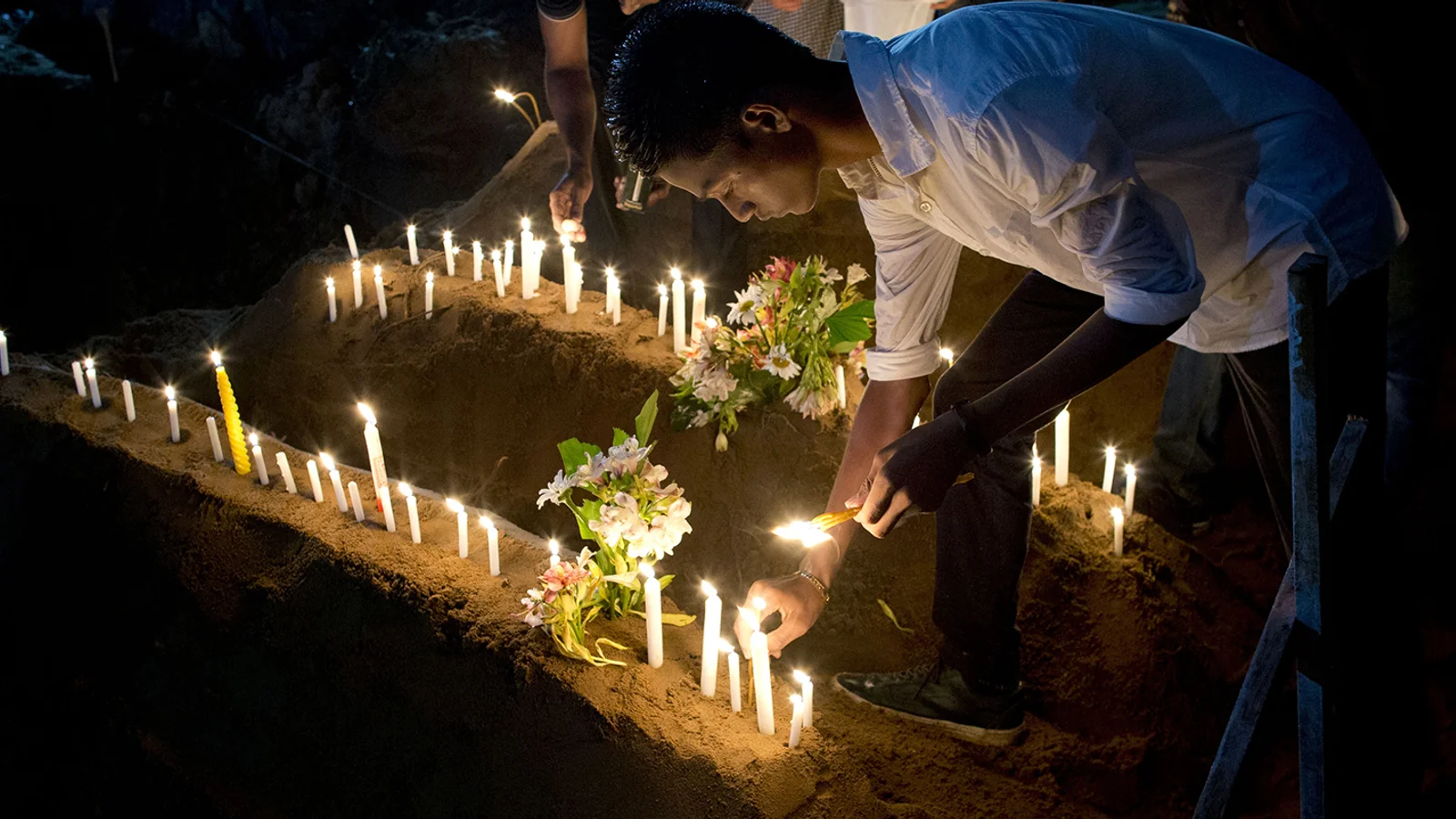

Image: Relatives light candles after burial of three victims of the same family, who died at Easter Sunday bomb blast at St. Sebastian Church in Negombo, Sri Lanka, April 22, 2019. | Gemunu Amarasinghe/AP- www.globalcitizen.org
Did the Rajapaksas, in their determination to regain power, do something equally criminal albeit not so stupid?
Mastermind or enabler?
In September 2018, DIG Nalaka de Silva was arrested under the PTA. He was accused of planning to assassinate President Maithripala Sirisena and presidential-hopeful Gotabaya Rajapaksa.
DIG de Silva’s accuser was an unknown man, Namal Kumara, heading an equally unknown outfit, Dushana Virodi Balakaya (Anti-Corruption Brigade). Addressing the media, Namal Kumara claimed that the mastermind of the assassination plot was Prime Minister Ranil Wickremesinghe. He had no evidence, he admitted, he just knew.
The Rajapaksa-led Joint Opposition (JO) embraced the tale. Addressing a September 19th press conference, organised by Namal Kumara’s outfit, parliamentarian Mahindananda Aluthgamage accused DIG de Silva of planning the conspiracy with the IGP’s connivance. “These conspirators are in an attempt to favour Prime Minister Ranil Wickremesinghe. We thought that only the Rajapaksas have become victims, but at present President Sirisena’s life is also at stake,” . In 2023, the courts released Nalaka de Silva after the AG admitted a lack of sufficient evidence. The assassination-plot drama had two momentous consequences. One was the anti-constitutional coup of 26 October 2018. The assassination-plot tale addled Maithripala Sirisena’s mind and made his shift to the Rajapaksa camp final. It also helped the future Easter bomber Zaharan Hashim escape arrest. Nalaka de Silva had been overseeing the TID investigation into Zaharan Hashim. His arrest pushed the investigation onto a backburner, giving Zaharan Hashim some much-needed breathing space.
These TID investigations had revealed how the anti-Muslim hysteria unleashed by the BBS in 2012 created pockets of radicalisation within the Muslim community. “After the Digana incident they published a lot of posts against Sinhala-Buddhist extremism. And from our Research and Analysis units we could see that they got many comments and likes,” the then acting head of the TID Jagath Vishantha informed the parliamentary select committee on the Easter Attack. “Zaharan started a campaign to radicalise Muslim youth and motivate them to use violence to achieve their ends post March 2018 attacks on Muslims in Digana…” the select committee concluded. “He was able to recruit many by using that incident and the Aluthgama incidents of 2014 to embrace the Islamic State of Syria and Iraq ideology.”
After the total extermination of the LTTE, the Rajapaksas needed an enemy potent enough to justify their project of familial rule and dynastic succession. Neither the Undead Tiger nor Christian Conversion Threat worked. So the BBS unleashed a wave of anti-Muslim hysteria with their Halal campaign. That hysteria would lead to the Aluthgama riots of 2014.
Afterwards, political pressure was exerted to release 13 of the men who were arrested even as the police were about to take their statements. Kalutara DIG V Indran was told by “an advisor of the Defence Ministry and a high placed official of the state intelligence service” to release the suspects immediately. When the DIG refused, his superior DIG Gamini Navaratne (who had received a call from ‘a powerful minister’) did so (Sri Lanka Guardian – 22.6.2014).
In late 2015/early 2016, the Sinha Le Movement (Blood of the Lion) erupted onto the political scene. As lead-organiser Madille Pannaloka thero revealed during a 2020 interview with A5 News in 2020, when the movement was in the making, Gotabaya Rajapaksa took part in ‘lengthy discussions’ and provided them with ‘certain guidelines’. “For one and a half hours he taught us tricks,” the monk said.
The Easter Sunday massacre was not inevitable. Had the Rajapaksas not unleashed the Muslim bogey in 2012 to stay in power and bolstered it in 2015-19 to regain power, that horror might not have happened. Even after the radicalisation was complete and the project was set in motion, it was preventable. Sri Lankan defence and intelligence authorities were provided detailed information about the coming disaster by foreign counterparts starting from 4 April 2019. In its report, the Parliamentary Select Committee pointed out that the SIS chief, MOD secretary, IGP, CNI, DMI “failed in their responsibilities. All were informed of the intelligence information prior to the Easter Sunday attacks but failed to take the necessary steps to mitigate or prevent it.” For example, head of the SIS Nilantha Jayawardane knew the names of several potential attackers: Mohamed Zaharan, Mohamed Milhan, and Mohamedu Rilwan by 21 April. Two days after the Massacre, Mahinda Rajapaksa told the parliament that his security officers had received the warning about the attack, but did not keep him in the loop. In its final report, the Parliamentary Select Committee wondered, “Whether those with vested interests did not act on intelligence so as to create chaos and instil fear and uncertainty in the country in the lead up to the presidential election.”
When the police came to the Dematagoda house of Ilham Ibrahim, the Shangri La bomber, his pregnant wife detonated a bomb, killing herself, her three children, and unborn baby. That horrendous deed is a testimony to the religious passion which motivated the bombers and some of their helpers. It also debunks the idea of a hidden Mastermind, a notion first made public by the Rajapaksa camp. But the possibility of a conspiracy of silence, even trusted enablers nudging true-believers away from certain targets towards others (such as from temples to churches) cannot be ruled out.
Did Suresh Salley play such a role? Was he the only one? On whose behalf did he act? Hopefully, the ongoing CID investigation will answer these and other related questions. If not, the Easter tragedy can be repeated, with different targets and different actors, but, ultimately, in the service of some fervid power dream. There’s nothing some leaders wouldn’t do for power, from butchering their own people to starting disastrous wars.
From an article published in the Daily FT : “An evil man will burn his own nation to the ground to rule over the ashes” – Attributed to Sun Tzu