
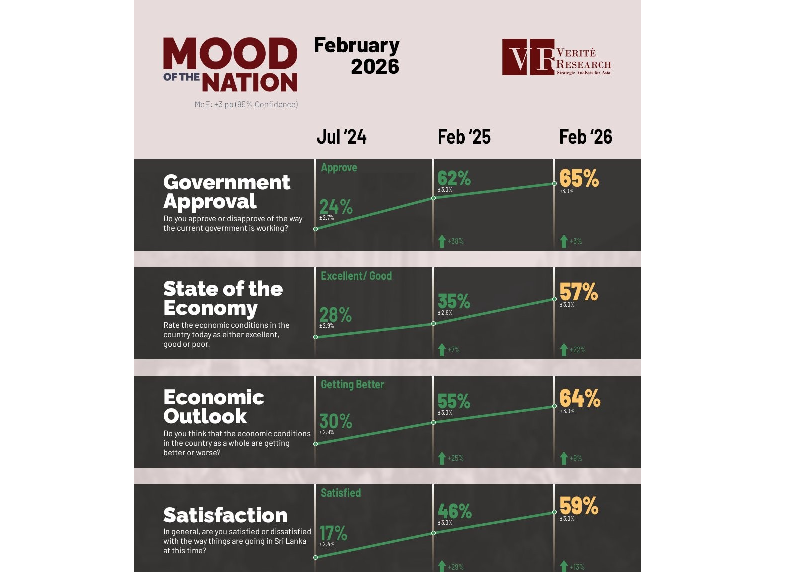

In an interview, Executive Director of Verité Research Dr. Nishan de Mel said 59 percent expressed satisfaction with the way things were going in the country, the first time that figure crossed the 50 percent mark, in four years of polling. At the same time, 65 percent said they approved the Government. The survey also points to stronger economic optimism, with 64 percent saying the economy is moving in a good direction, even as de Mel cautioned that persistent poverty and cost-of-living pressures remain for millions.
Q: Verité Research has now released the February 2026 report of its “Mood of the Nation” survey. After four years of conducting this survey, what is the most notable change you see in this edition?
A: The most notable change in this report is the level of public satisfaction with regard to the country. For the first time in the four years since we began this survey, a majority of respondents, 59 percent, said they were satisfied with the “way things are going” in the country. In previous surveys, this has not crossed the 50 percent mark. We think this as a shift in overall public sentiment in a positive direction.
At the same time, approval rating of the Government has risen to 65 percent. Compared with 62 percent a year ago, this indicates that the popularity of the Government has remained statistically stable since the election.
Q: You say the Government has a 65 percent approval rating. However, the recent Local Government election results show a lower vote share for the Government. How do you explain this gap between the survey data and the election outcome?
A: This is a very important question. Government approvalas we have surveyed it, and voting in an election involve two different dynamics.
At a Local Government election, people do not decide only on national policy. They also focus on local issues, candidates who understand those issues, and candidates they know personally. So, in a Local election those other factors also influence how people will vote. That is my observation.
Q: How does this report reflect the “Economic Confidence Index” you use to measure public confidence in the direction of the economy?
A: The data confirm that people have developed a level of optimism about the economy that we have not seen before. All of the sentiments on the economy are aggregated into an Economic Confidence Index ranging from minus 100 to +100. As stated in our press release the index registered +36, a huge improvement from +14 a year ago.
The survey shows that 64 percent believe the economy is “getting better.” In February 2025, that figure stood at 55 percent. And the share who rated the current economy as “good” or “excellent” also exceeded the share who rated it as “poor”.
All of this indicates that people now hold more definite optimistic expectations about the country’s future, than they did in the past four years.
Q: In this survey, you also asked for public views on different Government activities. Which areas make people most satisfied?
A: As stated in our press release, in various other aspects where the present Government was evaluated against past Governments, the highest positive evaluation – that is, the percentage who said the current Government was doing better than the previous Governments – on reducing drugs and crime-even more so than for the positive evaluation on reducing corruption.
Q: Many people usually question the accuracy of the polling data. Can the views of around 1,000 people measure the opinion of an entire country? Can you explain the scientific method you use?
A: This is a very fair question. For this survey, we use a sample of 1,048 adults from across the island.
We select this sample to achieve a margin of error no more than plus or minus three percentage points, with a 95 percent confidence level.
To do that we divide the country into districts and then into Grama Seva divisions, and we collect data by selecting households through a randomised multi-stage sampling process. By doing this we protect the sample from being biased along party, ethnicity, gender, and similar factors.
We commission a professional survey firm, to collect and verify the data. This survey was conducted by Vanguard Survey( Pvt.) Ltd. They back-check the data they collect to ensure accuracy. It is always important to have a recognised professional firm collect and verify the data in this way.
Q: According to the survey, 64 percent say the economy as getting better. But some people still struggle with issues such as the cost of living, don’t they?
A: Yes. Public optimism does not mean that everyone’s lives have improved. When we work on the field its apparent to us that about 25 percent of the population live in poverty.
We have not seen a major change in the group that says the economy is getting worse. But the key point is that the group with “no opinion” has shrunk, and many of them have moved into the group that says the economy is improving.
This shows that people now hold a clearer and firmer view of the country’s direction than before.
Q: Can we treat these data as an early indication of the result of a future national election?
A: No, this is not a direct prediction of what will happen at a future election.
In this country, people consider many more complex factors when they make political decisions. In fact, the process is now even more complex than before. So, we cannot use these results to predict the future.
However, our data clearly show that people are increasingly convinced that the country is moving in a better direction. The Government’s 65 percent approval rating and the 59 percent satisfaction level with the way things are going in the country show broad public acceptance of the present administration.
Surveys like this can become an important factor in democratic engagement and understanding of public sentiment.