


Colombo — Sri Lanka’s state‑owned Ceylon Electricity Board (CEB) has estimated Rs. 7.67 billion in direct losses arising from eight recent coal shipments, amid growing questions over fuel quality, contract enforcement, and accountability in the country’s largest thermal power operation.
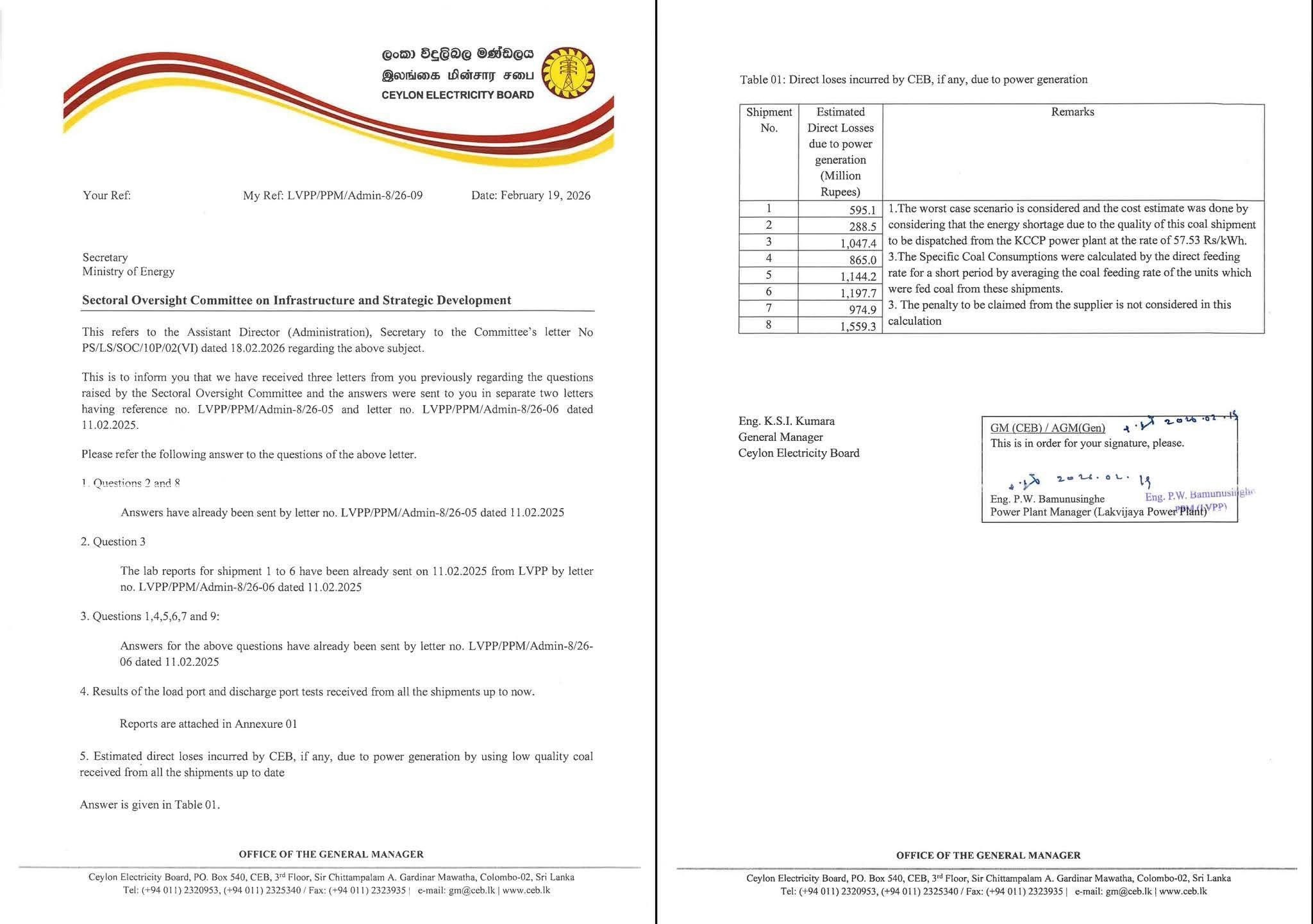
According to CEB calculations, the loss figure represents a worst‑case estimate based on the cost of replacing coal‑generated electricity with alternative power at Rs. 57.53 per kilowatt‑hour. Officials note that this estimate does not include any penalties that may be recoverable from the supplier under the relevant coal procurement contract.
Quality Concerns Raised by Plant Data
The loss estimate comes against the backdrop of serious quality concerns highlighted in investigative reporting by the Sunday Times, citing internal data from the Lakvijaya Coal Power Plant in Norochcholai.
According to the report, multiple coal shipments allegedly failed to meet key contractual quality parameters once burned at plant level. Reported figures show Gross Calorific Value (GCV) readings as low as 4,805 kcal/kg, compared to reject thresholds reportedly near 5,900 kcal/kg. In addition, ash content in some shipments was recorded above 22%, exceeding a stated rejection limit of 16%.
Lower GCV coal produces less energy per unit, while higher ash content can increase operational inefficiencies, maintenance requirements, and unplanned outages — all of which translate into higher system costs.
Conflicting Test Results Deepen the Dispute
The situation is complicated by conflicting test outcomes at different stages of the supply chain.
While discharge‑port testing reportedly indicated that the coal shipments met contractual specifications, plant‑side operational data tells a different story, suggesting performance significantly below expected standards once the fuel was actually used in generation.
The coal was supplied through India‑based Trident Chemphar, with sourcing traced to South Africa, according to the Sunday Times report.
Such discrepancies between port‑of‑delivery tests and in‑plant performance data are not uncommon in bulk fuel contracts. However, standard procurement practice typically provides mechanisms to address exactly this kind of dispute.
Why Has the Dispute Mechanism Not Been Triggered?
The coal supply contract is understood to include a “third‑umpire” or independent dispute‑resolution mechanism, designed to adjudicate cases where buyer and supplier test results diverge.
Despite:
- CEB calculating Rs. 7.67 billion in losses,
- Plant data allegedly indicating substandard coal, and
- Port tests suggesting contractual compliance,
the contractual dispute mechanism has not been formally activated.
No official explanation has yet been provided as to why this mechanism remains unused, raising concerns among energy sector observers about enforcement, oversight, and institutional decision‑making.
Penalties Absent From Loss Calculations
CEB’s stated loss figure does not account for penalties that may be contractually applicable if quality breaches are proven. This has led to further questions about:
- Whether penalty clauses are being pursued,
- Whether recovery actions are underway, and
- How potential recoveries are being reflected — or not reflected — in public financial reporting.
Without clarity on enforcement, the true fiscal impact on taxpayers remains uncertain.
Broader Accountability Questions
Taken together, the episode highlights what analysts describe as a procurement, enforcement, and accountability challenge within one of Sri Lanka’s most strategically critical state institutions.
Key documents and data that remain unavailable to the public include:
- The full coal tender documents and any subsequent amendments,
- Shipment‑by‑shipment test results from both port and plant,
- Penalty calculations and recovery status, and
- A formal explanation for the non‑activation of the contract’s dispute‑resolution process.
High Stakes for Public Finance
A loss estimate of Rs. 7.67 billion in public funds carries significant implications at a time when Sri Lanka continues to face severe fiscal constraints and elevated electricity costs.
Observers note that such a figure implies one of two possibilities: either a deliberate abuse of the procurement process, or serious institutional incompetence in contract enforcement.
Either scenario, they argue, raises uncomfortable questions for the administration and underscores the need for greater transparency and independent scrutiny in energy sector procurement — particularly where large‑scale public expenditure is involved.
Compiled using post by @chami9539