

Sabeer Mohamed.
While many communities affected by Cyclone Ditwah have begun returning to something resembling normal life, the hill country Malaiyaha community remains suspended in uncertainty.
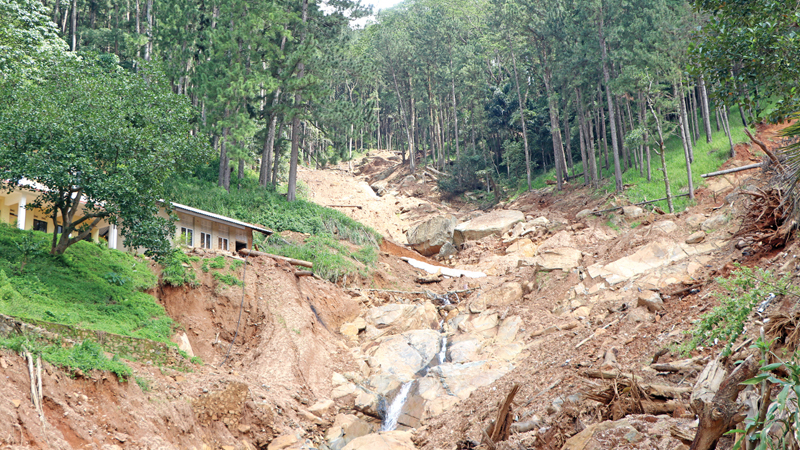
This became clear during a visit to the Gammaduwa village, under the Ambanganga Korale Divisional Secretariat in the Matale District. Here, the disaster did not end when the rain stopped.
Gammaduwa is home to nearly 1,500 families. Landslides have scarred large sections of the area, and the road ends abruptly beyond Gammaduwa Tamil Maha Vidyalaya. During the heavy rains of November 27 and 28 last year, this area recorded the highest rainfall in the country – 545 millimetres.
Visible and unresolved
Months later, the consequences remain visible and unresolved. Around 100 families had lost their homes completely. With nowhere else to go, some have moved into rented houses in distant areas, while 47 families continue to live in a temporary camp set up at Dhambagaha Muduna Vihara. Based on the recommendations of the National Building Research Organisation (NBRO), several families who were previously in camps have been instructed to return to houses now classified as being under a moderate level of risk. But for the residents, “moderate” does not mean safe.
Reaching Gammaduwa from Matale takes about one and a half hours by bus. Along the way, landslides interrupt the journey, and long stretches of the road are damaged or partially collapsed.
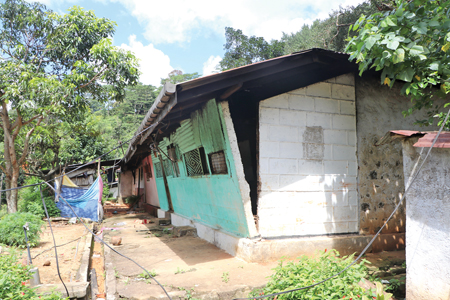
Praveen, 21, accompanied the Sunday Observer team as a guide. He was born and raised in Gammaduwa. His line house stood below his school. During the landslide, the primary section of the school was buried under the soil, and the earth mound above it collapsed onto the line of houses where Praveen’s family and 27 others lived.
Today, Praveen lives in a rented house in Kaikawala with his parents and three siblings. He had been preparing to sit the Advanced Level Examination this year. But he is now looking for work to support his sister’s studies instead.
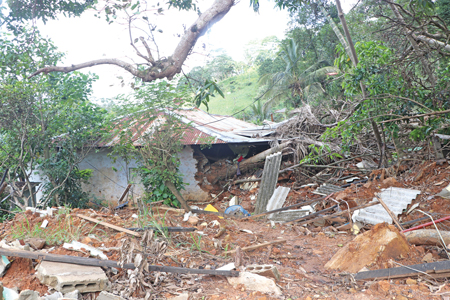
When we visited the site of his former home, several houses were still filled with more than a foot of dried mud. Some had sheltered four generations. Walls leaned outward. Grass grew where floors once were.
“We had no electricity for almost eight days. It kept raining on November 26 and 27. In the evening, my father and I went to clear some stones that had fallen on the road. That’s when the landslide happened.
“It sounded like four or five aeroplanes flying overhead at the same time. The earth collapsed in front of me and behind me. A huge stone flew over my head.
“I ran home and took my parents to the kovil nearby. Within seconds, the earth collapsed behind our house. We were trapped for two days. There was nothing to eat. We didn’t even understand what was happening to us. Two people died near my house.
“After two days, we came through the forest to a neighbouring village and shouted to see if anyone was alive.”
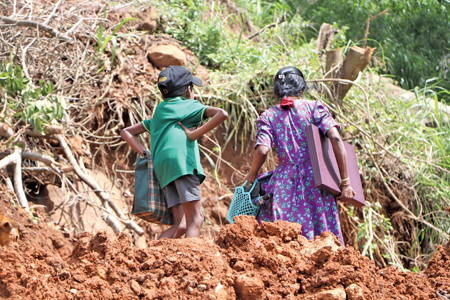
With the assistance of the Army, the survivors were eventually moved to relief camps. Praveen returned weeks later, only to realise that the houses in the area had been looted. Goats owned by residents had been slaughtered and cooked on the premises. Shops in the area had been broken into and stripped of goods. Even the idol of Lord Murugan from the local kovil had been stolen.
Rental houses
The Government has promised to construct new houses for families who lost their homes entirely and for those living in areas classified as high-risk following Cyclone Ditwah. Until land is identified and permanent houses are built, the authorities have assured displaced families access to rental houses or long-term shelters for up to six months.
Under this arrangement, families who find rental accommodation are supposed to receive a monthly allowance of Rs. 25,000 for six months.
But in plantation areas such as Matale, Badulla and Nuwara Eliya, families say rental houses are almost impossible to find. Where houses are available, landlords demand advance payments ranging from Rs. 100,000 to Rs. 500,000, sums far beyond the reach of families who have lost everything. Even houses with minimal facilities now command rents close to Rs. 25,000, inflated sharply after the disaster.
Residents accuse a section of landlords, unmoved by the disaster, of exploiting the crisis by raising rents and demanding excessive advances, effectively pricing survivors out of the only option offered to them.
Another layer of uncertainty comes from the assessment process of the NBRO. Only families living in areas categorised as “highly vulnerable” are eligible for permanent relocation schemes. Those whose lands are classified under a “central vigilance” category are instructed to return, even if their homes are damaged or unsafe.
For families sheltering at the Dhambagaha Muduna Vihara after fleeing Gammaduwa, this distinction has become a trap.
The NBRO report on their lands has not yet been issued. Despite this, residents say they have been asked to leave the temple by the 15th. Without the report, they cannot return home. If the report later classifies their area under central vigilance, they will not qualify for the rental allowance either.
Caught between pending assessments and eviction notices, families describe being pushed to “find houses” that do not exist.
When we visited the Dhambagaha Muduna Vihara, 48 families were still living there. Initially, the camp housed around 75 families, nearly 250 people, sharing just three toilets.
Navaratnam Venujani, one of the residents, said, “At the beginning there were many of us here. With only three toilets, different infections and viral fevers spread among our children. Even now, we don’t know where to go or what to do.” She said the temple’s Viharadhipathi had provided food and basic support, while Government assistance was minimal.
“They tell us every day to leave and go to rented houses. Where will we go? None of us has received the Rs. 25,000 allowance. The men go out as daily wage workers, but there is no steady work like before. We could not even recover the belongings from our destroyed houses.”
Displacement has also interrupted education. The Tamil school in the village remains closed. Only students sitting for GCE Ordinary Level Examination this year have been transported to follow classes through at the University of Peradeniya. Other children were advised to attend nearby schools, but parents say there is no transport and positive environment in the camp to send their children to school. “They went to school for just one day,” Venujani said.
The greatest struggle
In Gammaduwa, residents say the greatest struggle is not rebuilding walls, but proving that their suffering exists at all. Standing beside the collapsed rock face behind his home, with fresh water springs now seeping through the floor, S. Mayilwahanam questioned the promises made to disaster-affected families.
“Even if the President says in Parliament that we will be given Rs. 1 million, I have not received even Rs. 25,000 in a fair manner,” he said. “The authorities are deliberately discriminating against us, the hill country Tamils.”
Mayilwahanam’s house has been classified under a “central vigilance” category. On that basis, his family was instructed to return home from the relief camp. They have not received any rental allowance or financial assistance.
When residents questioned the local Grama Niladhari about the lack of support, they say they were told, “There is no disaster in your house.”
Grama Niladharini D. P. Jayarathnam told the Sunday Observer that when she visited the area, no one was present at the house.
In the Gammaduwa Puthukudiyiruppu area, where Mayilwahanam lives, only one household has received the Rs. 25,000 rental allowance. There are 54 houses in that section. Of them, land ownership documents have been issued for only three.
Several residents said they have not received written assessment reports from the NBRO.
“Officials only give instructions verbally,” said Ramaiah Dinesh, another resident of Gammaduwa. “Most of it is in Sinhala. No one has officially visited our house. They say they came when we were not there.”
Dinesh said his house is now dangerously close to a collapsed river bank. Although NBRO assessments in parts of the area have reportedly classified some locations as high-risk, residents say the psychological impact of witnessing the landslide has been ignored. Despite fear and visible damage, families are being pressured to return because their houses are not officially recorded as destroyed.
Despite fear and visible damage, families are being pressured to return because their houses are not officially recorded as destroyed.
Nearly 90 percent of families in Gammaduwa depend on daily wage labour. Since the disaster, work has largely disappeared. With no income, no clear assessments, and no formal communication, residents say they have nowhere to turn.
Official response
We raised these concerns with Ambanganga Korale Divisional Secretary Thusitha Udesh Dissanayaka on January 16. He said the NBRO has completed surveys of houses belonging to families currently sheltering at Dhambagaha Muduna Vihara, and that the reports would be available shortly.
According to him, the residents currently at the temple are those living in high-risk houses, and arrangements are being made to relocate them to alternative camps in the Pabillai and Pitakanda areas.
The Divisional Secretary said the Rs. 25,000 allowance can only be provided to families whose houses are classified as completely damaged, and that immediate action is limited until all NBRO reports are finalised. He also said that new housing projects and school reconstruction programs have been initiated.
However, residents told us they have not yet received individual NBRO reports, despite being instructed to act on their findings. The Malaiyaha people did not arrive in Sri Lanka as strangers yesterday. They came nearly two centuries ago as plantation workers and built an economy with their labour. Every Government has acknowledged that contribution in words.
In Gammaduwa, that history has narrowed into something painfully immediate. Families who survived a landslide now struggle to prove that their loss is real.
They are asked to return to their damaged homes without written clearance, instructed verbally in a language many do not fully understand, and denied assistance because their suffering does not fit neatly into administrative categories.