
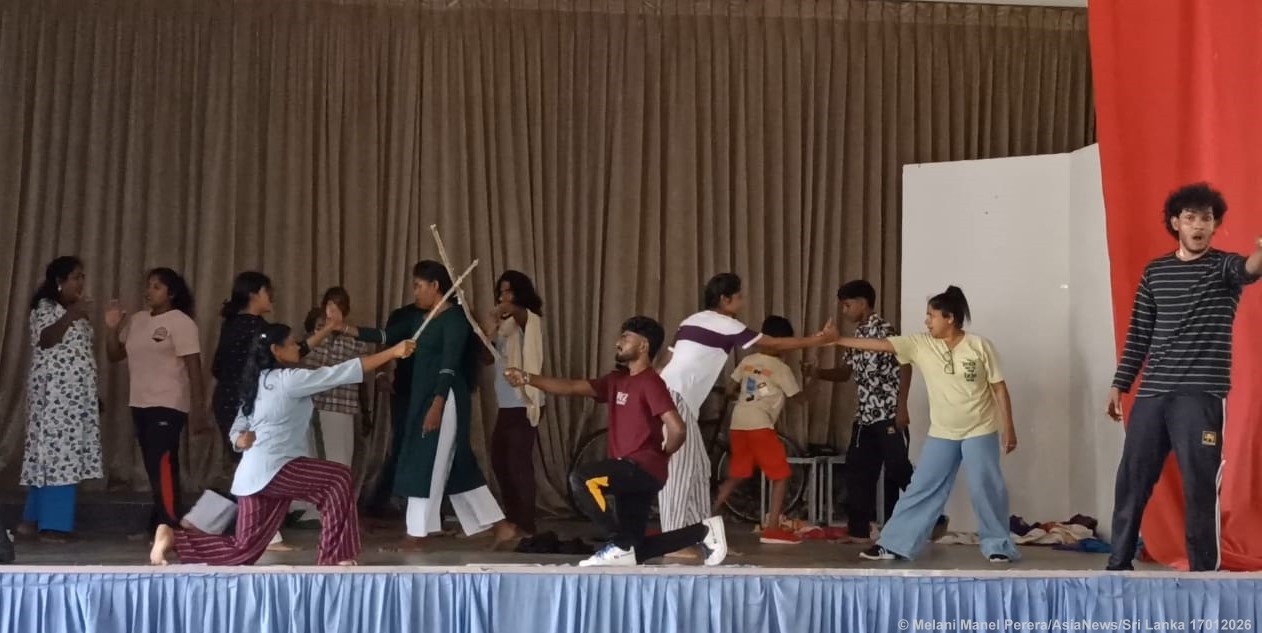

“Come, let us forget the bitter past with understanding, and build a country where we can live together in peace.” These words resonate through the stage play Yakawewata Nandikadal, which will be performed at the Bandaranaike Memorial International Conference Hall (BMICH), Colombo, on January 23, 2026, under the Kamatha theatre. The play revisits the harsh realities reflected in several real-life stories while powerfully calling for genuine reconciliation.
The foundation of this production, rooted in a history shaped over many years, emerged from a series of workshops initiated by the Office for National Unity and Reconciliation (ONUR) Since in 2025.
“on 19th of May 2025, we met with groups from Yakawewa in Kebithigollewa and from Nandikadal in Mullaitivu—communities deeply affected by the war. We lit lamps and offered prayers in remembrance of all those who lost their lives, and we sought to share their life stories. So we met them on the 28th of May and this healing stage play, Yakawewata Nandikadal, was born out of that sharing,” said Mr. Wijith Rohan, Chairman of the Office for National Unity and Reconciliation, explaining the origin of the production.
Mr. Wijith Rohan stated that throughout this drama, it speaks about lives that have faced war, about loving life, about pain, and about how pain is shared and commemorated, and that through it one can also see how they were healed.
“This incident took place when Nithya was studying in Year Two at Mankulam School. It happened on June 15, 2006—the same day the bomb attack on the bus in Kebithigollewa occurred. On that day, the army fired mortars at a terrorist camp near Nithya’s school. Many children lost their lives, unable to endure the terror and the sound of the explosions. However, Nithya survived because her teacher shielded her by holding her tightly… Yes, on June 15, 2006, I was teaching at Mankulam Maha Vidyalaya in Mullaitivu.” This narration forms a pivotal moment that shapes the emotional core of the play.
Running parallel to this dialogue, the visual backdrop on one side of the stage undergoes a transformation. The character of Nithya, a Year Two student at Mankulam College, then appears on stage. Artist Lalith Athauda brilliantly demonstrates his creative skill by achieving striking visual transitions through changes in lighting.
The production is further strengthened by the collective contribution of a dedicated creative team: S. Jeevaraj as Assistant Director, Hemantha Chandimal Liyanapathirana as music director, and Danuka Malinda Balasuriya as stage manager, all of whom generously contribute their talents to the production.
These collective efforts support the vision of Gayan Randheera—a graduate in Drama and Theatre Arts from the University of Kelaniya and a young theatre practitioner—who wrote the script and directed the play. Through his sensitive handling, the true spirit of Yakawewata Nandikadal is revealed to the audience with honesty and depth, without compromising the integrity of the real-life stories on which it is based.
Presented simultaneously in both Tamil and Sinhala, the play transcends language barriers. Gayan Randheera’s direction ensures that audiences can grasp both visual and auditory elements seamlessly, making the experience accessible and impactful.
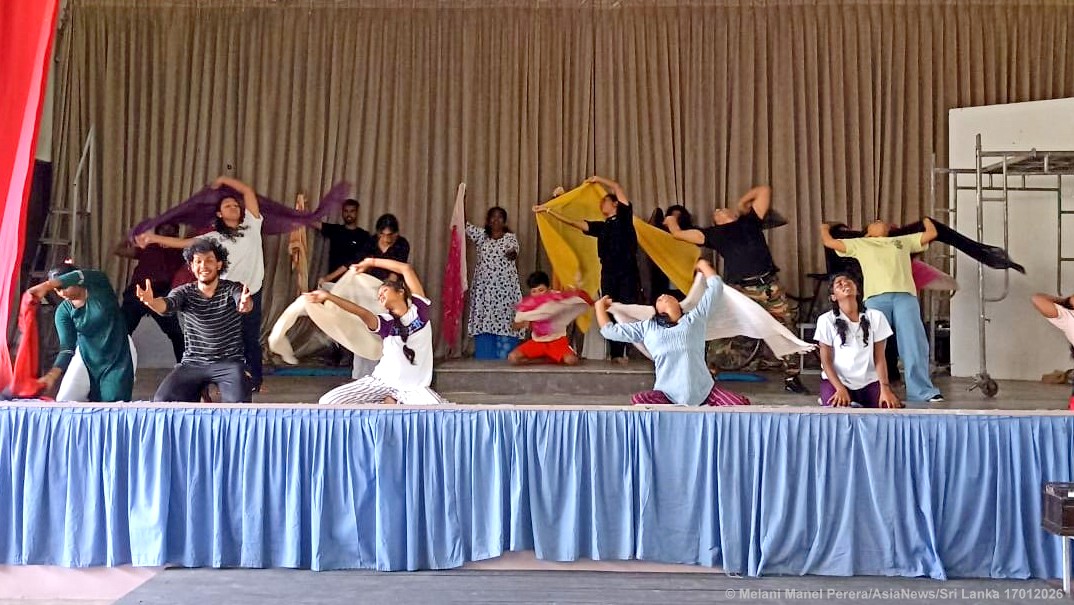
Moreover, the involvement of all actors and actresses in the choir adds a powerful layer of authenticity to the production. Not only through dialogue, but also through song, the genuine tones of their own experiences, crisis, pain, and hope, resonate deeply, further enriching the emotional reality of the play.
The characters who bring Yakawewata Nandikadal to life emerged through one of the initiatives undertaken by the Office for National Unity and Reconciliation (ONUR) as part of its programmes aimed at healing society. Around May 2025, a group of Sinhala and Tamil youth—young and old, women and men, from Anuradhapura, Kebithigollewa, Mullaitivu, and Nandikadal, regions deeply scarred by the war, began this collective journey of healing.
Except for one participant, none of the performers are trained actors. They are individuals who spoke two different languages—Tamil and Sinhala, and came together on a shared platform created by ONUR to tell their own stories of war and loss. Over time, through the strength of this platform and the process it fostered, they have grown into one family.
“I decided to join this play because of the extremely important work being done by ONUR. As citizens, we have a national responsibility to support such efforts,” said Gayan Randheera, director of Yakawewata Nandikadal, reflecting on the challenge of bringing this production to life.
Explaining the creative process, he noted: “This play was created with people selected through the National Integration Officers attached to the office. I wrote the script based on their inner stories. The entire group consists of 45 participants, but only 19 appear on stage. None of them are actors—except for one male who has some theatre experience. The others have no acting background. That is why I chose to create the play in a forum-theatre style.”
According to Randheera, the most difficult aspect of his role was working with a group unfamiliar with dramatization, while also overcoming language barriers and practical challenges that arose during rehearsals.
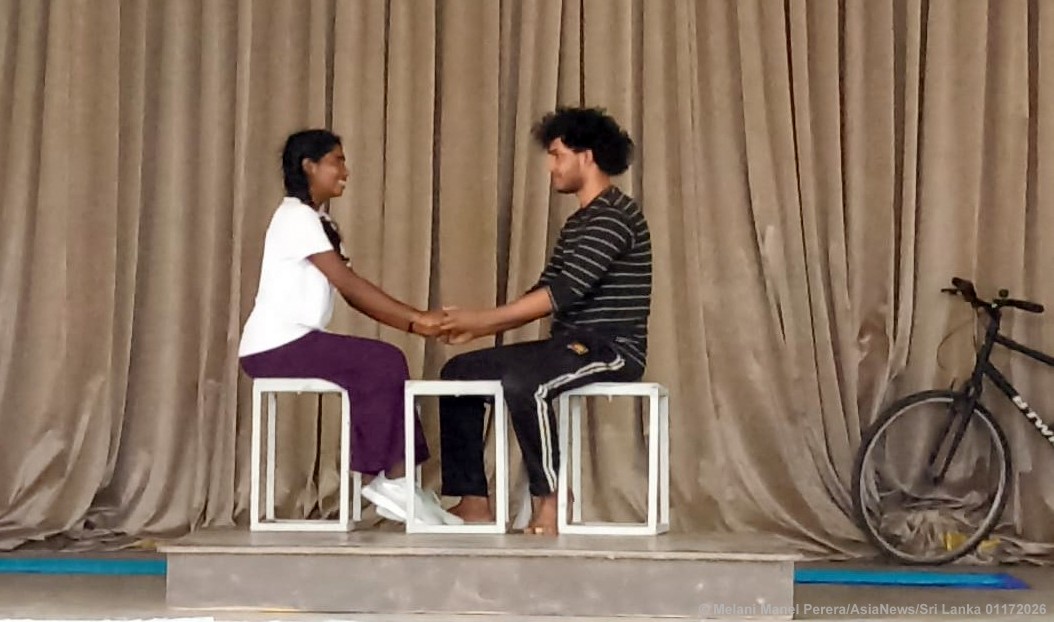
“The greatest challenge was addressing the hatred,” he added. “Initially, there was distrust and suspicion on both sides. An unspoken bitterness existed in their hearts. But after going through the workshops together, things began to change. Understanding and affection replaced suspicion, and eventually we started working together like one family. That makes me truly happy.” He shared this with visible pride in the collective achievement of Yakawewata Nandikadal.
The play opens with a conversation between Vihanga Sathsara, a young Sinhala student, and Nithya, a Tamil student, both studying at the Eastern University. They are lovers. Sathsara lost his parents in the Kebithigollewa bus bomb attack and now lives with his grandfather. Nithya, too, is a child victim of war. She was born in an internally displaced persons’ (IDP) camp and grew up without a father. Her mother, who once lived in a border village, narrowly survived a violent clash between the army and Tamil militants and later lived in an IDP camp. All her relatives were lost to the war; Nithya and her mother now have only each other.
Yakawewata Nandikadal weaves its beginning, middle, and end through images, dialogue, dance, song, conflict, lamentation, light, and sound, presenting the audience with real-life stories of grief and hope from two sides of the conflict. Merely staging and watching these lives is not enough to do justice to them. Thousands of similar stories—like those portrayed in Yakawewata Nandikadal—continue to cry out for justice and fairness in this country, particularly in regions devastated by war and bombings.
“Yes, indeed, we must work to transform the trust placed in us by the Tamil people of the North and East into reality. To this end, our office is pursuing various initiatives. From time to time, we witness the emergence of racist and religious extremist tendencies in the country; therefore, we must continue this journey toward national unity and reconciliation,” said Chairman Wijith Rohan.
Emphasizing the need for a broad ideological discourse, he noted that his office has been engaged in discussions on this matter since last year and that a national policy on unity and reconciliation has already received Cabinet approval to begin the process.
“I believe the greatest responsibility of our office is to engage the United Nations, build consensus, and establish a comprehensive national policy. Within such a policy framework, there will be ample space to engage in an inclusive and wide-ranging discourse on reconciliation.” This, he said, reflects a message of hope.
While it may be long overdue to truly listening to these voices, it is not too late. In this context, the Office for National Unity and Reconciliation bears a deep and far-reaching responsibility. Yakawewata Nandikadal should be seen as a beginning.
Even years after the end of the conflict, and despite the long existence of institutions established for national reconciliation, tangible progress has often been limited. Against this backdrop, the steps taken through Yakawewata Nandikadal are truly commendable.
It must not be forgotten that the Office for National Unity and Reconciliation has both the mandate and the moral authority to introduce and pursue non-violent, humanitarian initiatives that encourage people in a small country like Sri Lanka to live together peacefully, with one shared humanity—beyond divisions of ethnicity, religion and groups. This responsibility arises from the power entrusted by citizens to protect human dignity and nurture a just, compassionate, and harmonious society.
END.
Melani Manel Perera – Journalist & HR Activist
[email protected]
077 2 539 167 / 071 9 600 167