
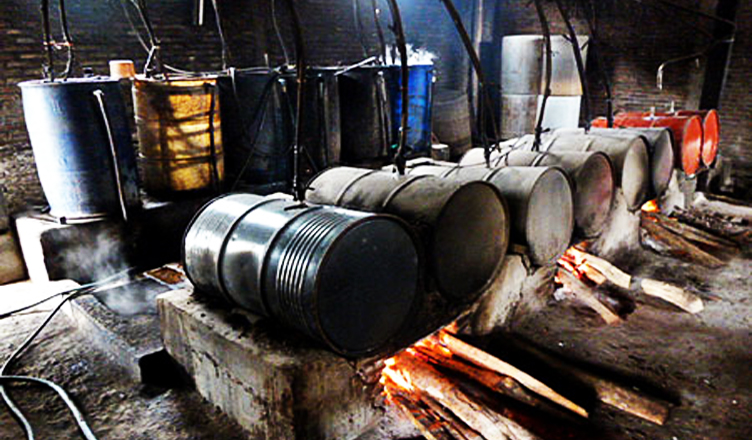

Image: Illicit liquor ( Kassippu) is a major business in Sri Lanka.
By Sunil Rupasinghe.
The Sri Lanka Public Health Inspectors’ Association claims that surveys have confirmed that around 37 per cent of all alcohol consumers in Sri Lanka used illicit liquor.
According to Chamil Muthukuda, Secretary of the PHI Association, alcohol consumption is on the verge of creating a serious economic and public health crisis in the country. Thus, this issue needs immediate intervention without further delay, he emphasised.
According to the World Health Organisation, the use of illicit liquor in Sri Lanka had increased by more than 300 per cent, while global data reports showed that overall alcohol consumption had risen by about 95 per cent. These reports also indicated that 37 per cent of alcohol consumption in Sri Lanka involved illicit liquor, he said.
Muthukuda noted that alcohol consumption was a major contributor to the rise of non-communicable diseases, and that harmful chemical substances found in illicit liquor, such as methyl alcohol and heavy metals, caused severe damage to internal organs.
He said conditions, including malnutrition, cirrhosis, kidney disease, and cancers, along with serious damage to internal organs, were linked to alcohol consumption. He further stated that alcohol use was a root cause of many social and health issues, including family disputes and mental stress.
According to data from the Ministry of Health in collaboration with the World Health Organization, in Sri Lanka, 15,000 to 20,000 deaths annually occurred either directly or indirectly due to alcohol consumption, with 40 to 50 deaths reported daily. Statistics also confirmed that 20 per cent of fatal accidents were caused by alcohol use.
He added that 85 per cent of deaths related to drugs and alcohol were due to non-communicable diseases, and that one in every four deaths was linked to alcohol consumption. As a result, Sri Lanka’s health and economic systems suffered an annual loss of approximately Rs 237 billion, he said.
Massive protest in Noori Estate
Meanwhile, a massive protest was held recently (6) by residents of Noori Estate, within the Noori Police Division in Dehiowita, Kegalle District, following the mysterious death of a 14-year-old boy. The protest was organised, demanding justice for the child’s death and calling for the eradication of the illicit liquor menace, which residents claimed was responsible for the incident.
The 14-year-old boy, a resident of Noori Estate, had died on the 2nd of this month. Residents alleged that the boy’s parents were heavily addicted to illicit liquor (moonshine), and that their severe alcoholism had directly or indirectly contributed to the child’s mysterious death.
More than 200 estate workers participated in the protest, during which strong slogans were raised against the illicit liquor trade.
Protesters stated that numerous families had been destroyed due to the widespread availability of kasippu in the estate sector. They also expressed concern that young women and girls were being subjected to sexual abuse as a result of alcohol consumption, and warned that even schoolchildren were becoming addicted, posing a serious threat to the destruction of society as a whole.
The Opposition Leader of the local council visited the protest site and held discussions with the public. Addressing the media, he said: “The current President has prioritised the suppression of drugs and alcohol in the country. Under our government, we will take the necessary steps to completely eradicate the kasippu problem in Noori Estate. Public cooperation is essential for this effort.”
Residents urged the Government to intervene immediately to completely stop the kasippu trade in Noori Estate, in order to protect their children’s future and prevent further loss of life due to such causes.
On the same day (6 January), in a separate incident, seven individuals from the Thambarawila area in Waikkala, Wennappuwa, who had fallen seriously ill after consuming illicit liquor, died.
The deceased were employees of a grinding mill in the Waikkala–Thambarawila area. They had consumed illicit liquor two days ago, after which they reportedly developed complications on several occasions.
Of them, two were found dead inside the grinding mill last morning. Three others, who were in critical condition at the time, were rushed to the hospital by residents, of whom two died on the following day.
In a related development, three individuals at a nearby vehicle repair workshop displayed severe symptoms of illness. Two of them subsequently died. In addition, another person residing in a house close to the grinding mill was found dead last morning.
The Wennappuwa Police were conducting further investigations into the deaths, with strong suspicion that the consumption of illicit liquor was the cause. A woman suspected of selling the illicit liquor had been arrested in connection with the incident, the Police said.
Meanwhile, previously released global data reports by the World Health Organisation revealed that alcohol consumption in Sri Lanka had increased by 95%. According to those reports, 37% of total alcohol consumption in the country consisted of illicit liquor.
The reports further indicated that the use of illicit liquor in Sri Lanka had surged by as much as 300%.
Local health officials warned that the continued rise in illicit liquor consumption would soon become a major national issue. They stressed the urgent need to take immediate measures to curb the use and distribution of illicit liquor.
WHO data paints troubling picture
World Health Organisation data already paints a troubling picture. Alcohol consumption in Sri Lanka has reportedly increased by 95%, with more than a third from illicit sources. Even more alarming, illicit liquor use has surged by as much as 300%. These are not abstract statistics; they translate directly into hospital wards, Police reports and funeral pyres. The Waikkala deaths brought these numbers into tragic focus.
Illicit liquor is dangerous not merely because it is illegal, but because it is unregulated, untested and often deliberately adulterated. Methanol contamination and inconsistent alcohol content turn every drink into a gamble with death. Unlike licensed alcohol, there are no standards, inspections or accountability beyond sporadic raids. Consumers, many driven by poverty and addiction, are left exposed to substances that can cause blindness, organ failure or sudden death.
Yet, focusing solely on enforcement against small-scale sellers risks missing the wider reality. Persistent demand does not exist in a vacuum. High legal-alcohol prices, uneven enforcement, economic hardship and limited access to treatment all contribute to the problem. When livelihoods are insecure, the cheapest available escape often becomes the most dangerous.
Successive governments have acknowledged the threat posed by illicit liquor, particularly in rural and semi-urban areas, yet responses remain fragmented and reactive. Crackdowns tend to follow mass poisonings, only to fade as public attention shifts. This cycle of outrage and neglect has proven deadly. What is required is a comprehensive, sustained national strategy.
Proper regulation lies at the heart of the response. Enforcement must target large-scale producers and distributors, coupled with intelligence-led policing rather than ad hoc raids. Supply chains, raw materials and organised networks need systematic dismantling. At the same time, legal-alcohol frameworks require careful review to ensure pricing and availability do not push consumers toward unsafe alternatives.
Public health interventions are equally critical. Awareness campaigns must go beyond generic warnings, addressing the specific dangers of illicit liquor through local languages and community outreach. Health services must be equipped to identify and respond rapidly to poisoning, while long-term investment in addiction treatment and counselling remains indispensable.
The Waikkala tragedy also underscores the importance of community vigilance. Residents are often the first to spot suspicious sales or clusters of illness. Empowering local authorities and communities to report and respond quickly can save lives, provided these mechanisms are supported and protected by the State.
Ultimately, the deaths in Wennappuwa were not inevitable. They resulted from regulatory gaps, policy inertia and social neglect. Each life lost is a reminder that illicit liquor is not a fringe issue, but a national public health emergency. Treating it as an occasional law-and-order problem rather than a systemic crisis will only lead to more tragedies. Proper regulation, robust enforcement and sustained public health measures are no longer optional; they are a moral and civic imperative. The cost of inaction has already been measured in human lives, and the nation cannot afford to pay it again.
By Ceylon Today