
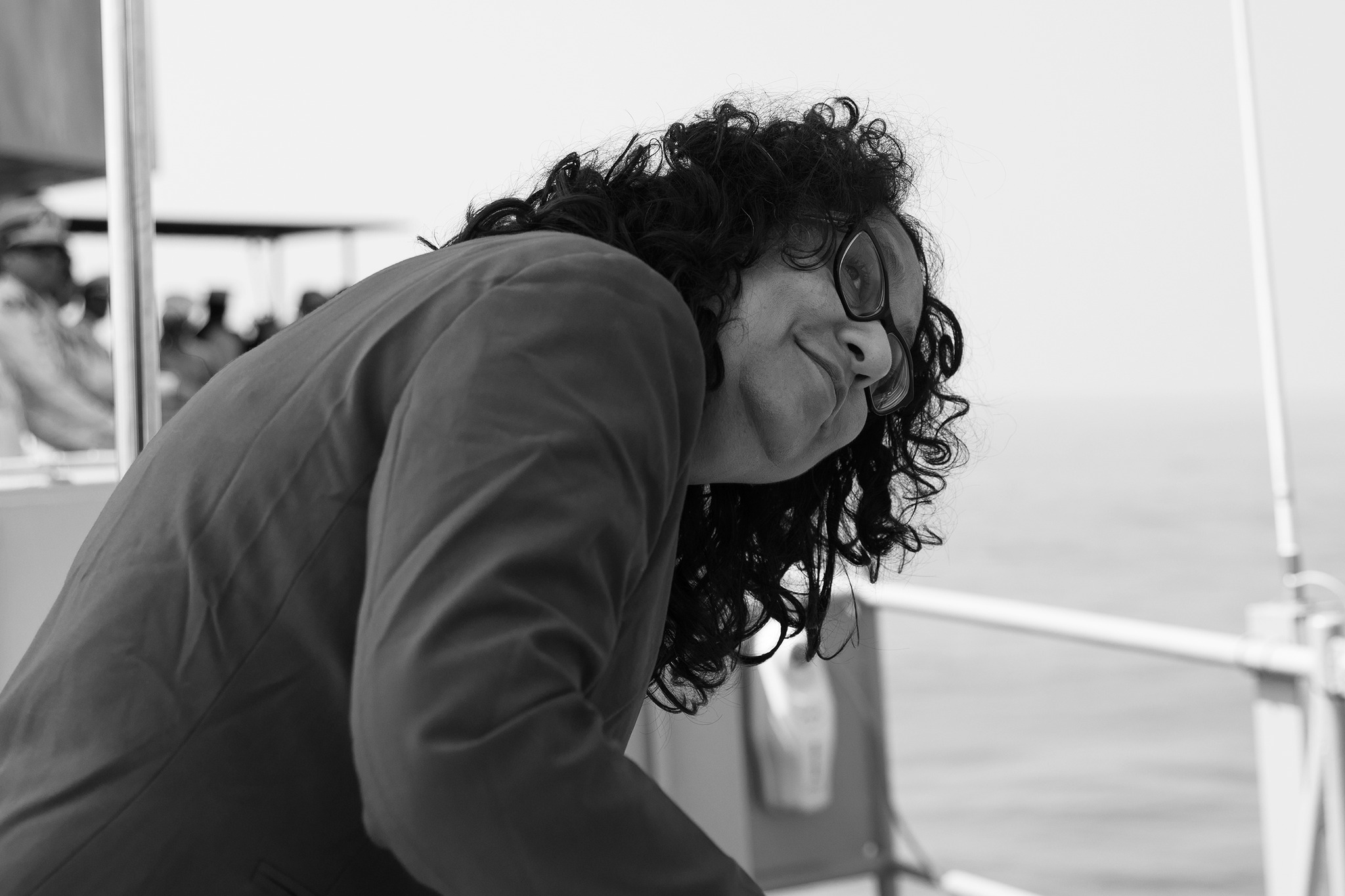

Image of PM Amarasuriya from Anuruddha Lokuhapuarachchi FB.
A single mistake that was in a Grade 6 English textbook has ignited a huge firestorm in Sri Lanka. What should have been a straightforward quality control issue has instead become a full-blown political crisis. This has raised urgent questions about accountability, democratic discourse, and the future of education reform in the country.
The problem was a serious one. A website link in the new Grade 6 English module, intended for educational purposes, instead directed students to an adult content site. This error appeared in three locations within the newly printed textbook, part of broader education reforms led by Prime Minister and Education Minister Dr. Harini Amarasuriya’s NPP government.
Before the modules reached students, social activists discovered the mistake. The government’s response was swift. Distribution halted immediately, warehouse stock sealed, and the problematic website blocked through telecommunications authorities. Prime Minister assured Parliament that no schoolchildren had accessed these modules.
This was undeniably a serious oversight. In an era where child protection should be paramount, such an error is inexcusable. The question is what happens next?
Multiple investigations were launched immediately. A three-member committee of Senior Additional Secretaries submitted a preliminary report within two days. A further investigation under a retired Ministry Secretary was initiated, while the Ministry Secretary requested a Criminal Investigation Department probe to determine whether the error was deliberate sabotage intended to embarrass the government. The head of the National Institute of Education was asked to step down to ensure a fair and transparent inquiry.
The National Institute of Education has formally removed the controversial lesson, and revised modules are scheduled to be distributed on January 21, 2026. Dr. Amarasuriya announced that future textbook printing would shift entirely to the Department of Educational Publications to improve oversight. The government also committed to developing a national policy for child protection in technology use and ensuring future modules would not rely on mandatory web links.
As of now, the investigations continue. The Prime Minister has assured Parliament that legal or disciplinary action will be taken once accountability is established.
The story takes unsettling turn when the opposition, led by Mr Sajith Premadasa, initiated a no-confidence motion against the Prime Minister. What began as a justified concern has evolved into something darker. A vicious campaign of personalised attacks against the Prime Minister has crossed the boundaries of civility and decency.
Rather than focusing on policy solutions or systemic improvements, the opposition appears to be targeting her personally. Many observers describe this as a veiled, organised campaign aimed at destabilising the government. These attacks have become increasingly gendered, focusing on her as a woman in power rather than on her professional performance.
This pattern is not unique to Sri Lanka. Julia Gillard faced similar campaigns during her time as Prime Minister of Australia. This demonstrates how female leaders globally often face disproportionate personal attacks rather than policy-focused criticism. However, recognising this pattern does not make it acceptable anywhere in the world.
Lost in the political theatre is the fact that Sri Lanka’s education system desperately needs reform. The country’s education sector faces serious challenges, including funding gaps, rural-urban disparities, outdated curricula, teacher training shortages, and poor alignment with job market needs. Despite the acquired historical strengths in literacy, Sri Lanka struggles to compete with knowledge economies, hampered by weak STEM focus and inequitable access.
The 2026 National Agenda aims to address these issues through competency-based learning, transitioning from exam-centric to activity-based approaches. These reforms target students in grades 1 and 6 by reducing daily subject periods to seven sessions of 50 minutes each and implementing a uniform preschool curriculum from 2027.
Should this entire reform process be derailed by a single error, no matter how serious? Absolutely not. However, the error highlights the critical need for better quality control, stakeholder consultation, and transparency.
The textbook error reveals a fundamental problem. The government’s “closed-door” approach to education reform is unsustainable. This is not just a typo. It is a crisis of confidence that demands systemic change.
The government needs to be much more open. Future reforms should go beyond bureaucrats and be subject to rigorous scrutiny involving a range of experts including educators, religious leaders, and parents. A broader range of consultative discussions is crucial for national consensus and addressing cultural sensitivities. Publishing reform details through white papers and involving the public in oversight, would avoid future mistakes and build trust.
The investigations must identify failings in the multi-layered review process. How did this error slip through? Who was responsible at each stage? These questions demand answers, and accountability must follow.
Everyone has the right and duty to criticise government actions, identify mistakes, and demand accountability. The government should respond genuinely to such criticisms and address weaknesses. Indeed, the government acknowledged the textbook error and welcomed calls for investigation. These are positive steps toward transparency.
However, there is a crucial difference between legitimate criticism and destructive attacks. When criticism of anyone becomes personalised abuse based on gender rather than professional performance, it damages democratic discourse and threatens social stability.
The vilification campaign against the Prime Minister needs to stop immediately. The destabilisation manoeuvres led by political right-wing groups, nationalists, fundamentalists, and extremists, collaborating without coherent policy alternatives but united only in their determination to overthrow a duly elected government, represent a dangerous path.
History has shown us where such campaigns lead a society to. If this continues unchecked, it endangers the entire society and risks violence.
Sri Lanka finds itself in a precarious situation. The country can use this crisis as a catalyst for meaningful reform, implementing better quality control, embracing transparency, and building consensus around education policy. Or it can allow political opportunism to disrupt necessary changes, sacrificing children’s futures on the altar of partisan warfare.
The Grade 6 module error serves as a critical stress test, revealing systemic weaknesses that must be addressed. The macro education reform agenda should not be destabilised by this error. Instead, this crisis should prompt a pivot from closed-door development to inclusive vetting, maintaining public trust while achieving the ambitious goals of modernising education.
The government’s sweeping electoral victory was widely unexpected. The scale of the mandate appears to have caught its leadership unprepared. Coherent policies and clearly articulated strategies were slow to emerge. A lack of experience in using the media effectively to communicate intentions and decisions to the public was noticeable. Inevitably, this resulted in a series of missteps in the early days of office. While such errors may be understandable during the customary 100-day “honeymoon” period, they cannot and should not be excused beyond it.
Sri Lanka needs constructive criticism that strengthens governance, not destructive attacks that threaten stability. We must demand accountability for the textbook error while defending civil discourse and the democratic process itself. Only through this balanced approach can the country move forward productively.
The time to stop the personal attacks is now. The time to focus on building better systems is also now. Sri Lanka’s children – all of them – deserve nothing less.
12 January 2026