
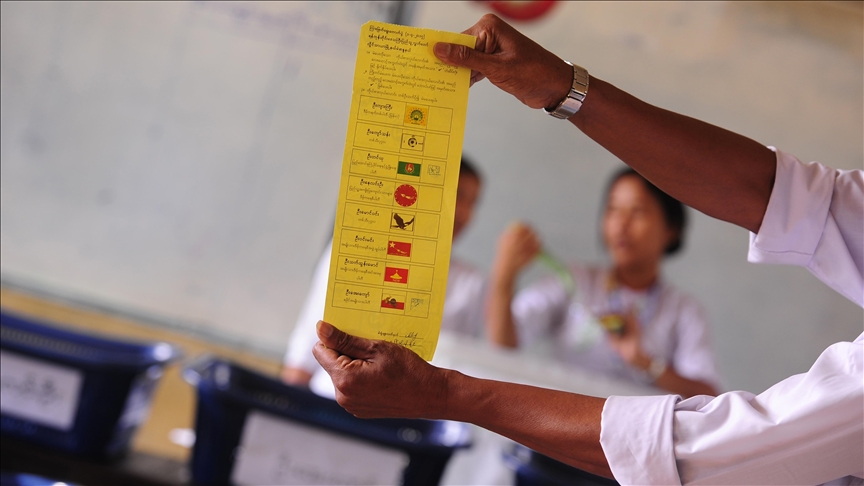

(Sri Lanka Brief) – The first phase of Myanmar’s controversial voting process on 28 December has drawn sharp condemnation, with critics branding it a “junta-orchestrated sham” aimed at cementing military control rather than reflecting the will of the people.
Independent expert Tom Andrews, who does not speak on behalf of the UN Secretariat, said the polls were “neither free, fair nor legitimate,” describing them as a “theatrical performance” designed to mislead the international community while exerting enormous pressure on citizens to participate.
“The international community should make clear that Myanmar’s future belongs to its people, not to those who imprison, silence and terrorise them,” Andrews urged, calling on Member States to reject the process, isolate the junta and demand cancellation of the remaining two voting phases scheduled for 11 and 25 January.
A Country in Turmoil
The staged elections come nearly five years after the military seized power in a February 2021 coup, plunging Myanmar into widespread armed conflict. Since then, the junta has faced fierce resistance from a coalition of ethnic armed organisations and newly formed People’s Defence Forces (PDFs), which have gained significant ground in several regions. These groups, operating under the banner of the National Unity Government (NUG), have vowed to dismantle military rule and restore democratic governance.
The intensifying conflict has triggered mass displacement, economic collapse and deepening humanitarian needs, compounded by devastating earthquakes in March 2025. Analysts say the junta’s inability to hold polls in at least 65 townships and thousands of village tracts underscores its waning control over large swathes of the country.
Low Turnout and Coercion
Reports indicate voter turnout in the first round was extremely low despite threats and intimidation. The National League for Democracy (NLD), which won landslide victories in 2015 and 2020, was barred from participating after being dissolved by the military. Its leader, Aung San Suu Kyi, remains in detention, with her condition unknown.
Official results show the junta-backed Union Solidarity and Development Party claiming nearly 90 per cent of contested seats in the lower house—a result Andrews said “should surprise no one,” given the polls were engineered to guarantee military dominance.
Junta forces reportedly used threats of conscription to compel young people to vote, while displaced persons, students, civil servants and prisoners faced pressure under threats of losing access to humanitarian aid, education and essential services.
Resistance Voices: NUG Rejects Legitimacy
NUG leaders have dismissed the elections as a political farce. “These parties were rejected by the public in 2020. The upcoming sham election is not a viable solution to Myanmar’s crisis,” said U Nay Phone Latt, spokesperson for the NUG Prime Minister’s Office. He reaffirmed that the results of the 2020 general election remain politically legitimate and vowed that revolutionary forces will continue to adhere to the Federal Democracy Charter.
Acting President of the NUG Duwa Lashi La warned that the junta’s staged vote would only intensify resistance: “This sham election is designed to prolong military rule. It will not bring peace—it will spur revolution. We strongly urge regional countries to look beyond the Myanmar dictator and recognise the will of the Myanmar people.”
In an official statement, the NUG declared: “Only a genuine, inclusive, and democratic process—driven by the will of the people—can decide Myanmar’s future. The junta’s attempt to impose a sham election at gunpoint will be resisted by every means available.”
Escalating Violence and Humanitarian Risks
Resistance forces have stepped up attacks on military positions and infrastructure, while reports of deadly assaults on election officials have raised fears of further civilian casualties. Andrews condemned such attacks, stressing: “Targeting civilians by any combatants is illegal and unacceptable.”
UN officials have repeatedly warned that elections under current conditions risk worsening instability. Ahead of the vote, UN High Commissioner for Human Rights Volker Türk cautioned that civilians were being coerced from all sides in a climate of fear, violence and mass repression, leaving no space for meaningful participation.
Special Rapporteurs are independent experts appointed by the UN Human Rights Council to monitor and report on human rights situations. They are not UN staff and do not speak on behalf of the UN Secretariat.