
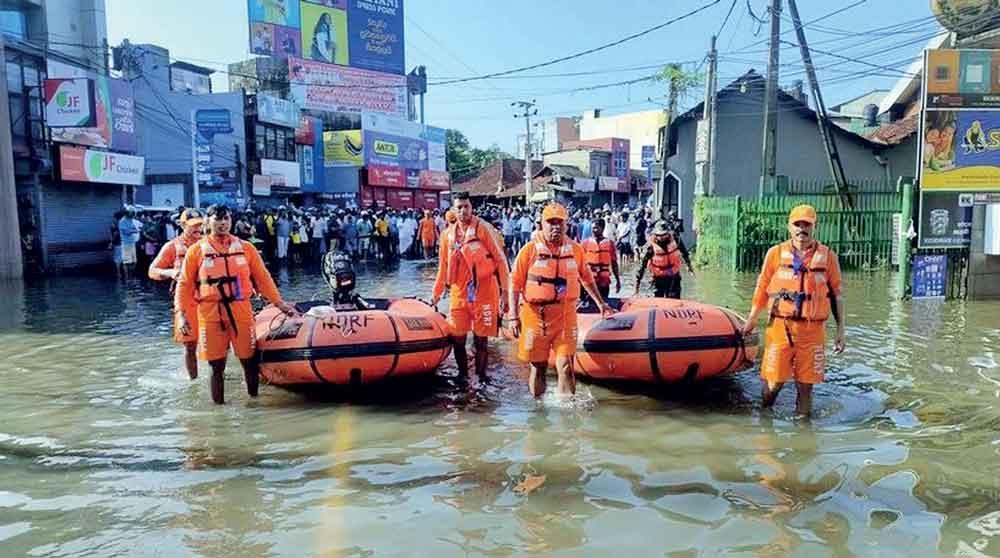

Image: Indian troops taking part in relief and rescue operations in a disaster-hit area. Pic courtesy X@DrSJaishankar.
Just as Canada’s social justice activist and writer Naomi Klein, in her highly celebrated book The Shock Doctrine: The Rise of Disaster Capitalism, explains the relations between disasters—manmade or natural—and vulgar capitalism driven by inhumane greed, so too can we see an inviting link between disasters and geopolitics.
In her 2007 book, she argues that disasters and wars are like honeypots for capitalist bees—or flies.
A follow-up book could similarly expose geopolitics’ rush into disasters. If Klein or someone else were to venture out, a compelling case study would be Sri Lanka’s recent disaster, where the killer cyclone Ditwah caused more than 600 deaths and leaving nearly 200 people unaccounted for.
Geopolitically speaking, the world is divided between nations with power ambitions and those vulnerable to falling prey to the power game. In other words, the world consists of geopolitical aggressors and geopolitical victims.
‘Geopolitics’ is a term initially employed, or at least popularised, in studies of geography’s influence on power. In his definition of geopolitics, Swedish political scientist Rudolf Kjellen in the early 1900s saw the state as a living organism whose survival depended on territorial expansion and strategic control. Just as a living organism requires space to grow, states, too, require expansion to survive.
Such political thinking led to wars, colonisation, and annexation of territories. Today, however, geopolitics is about the expansion of a nation’s political power in international relations. Power ensures survival. In pursuit of power, weaker countries become victims, and their sovereignty erodes in proportion to their vulnerability.
To understand geopolitics better, one must recognise that there is no free lunch in politics. Altruism is a deception. Foreign aid is a geopolitical tool. This holds true even when aid comes from United Nations agencies such as the International Monetary Fund and the World Bank.
In the World Bank’s assistance or the IMF’s structural adjustment programmes, offered as a panacea to debt-ridden or economically bankrupt countries, the once-hidden geopolitical agenda of the countries that dominate these institutions is increasingly evident today. Yet economically weaker nations have no option but to genuflect before powerful states to keep the taps open for international assistance. Often, they are forced to compromise their principled foreign policy stance on global justice issues—such as the Palestinian question—and to take morally questionable decisions to appease the powers that provide economic aid and tariff concessions.
In times of disaster, geopolitics manifests as disaster diplomacy. All humanitarian aid that nations rush carries shades of geopolitics, ranging from neocolonial ambitions to soft-power image enhancements. Even economically weaker nations send what they can to disaster-hit countries, often to enhance their image as compassionate states. In international relations, countries pay little heed to the spiritual advice: when you give to the needy, do not let your left hand know what your right hand is doing.
People-to-people aid is the exception. What Sri Lanka received from the tiny Indian Ocean nation, Maldives, is one such exception: the people there raised nearly one million US dollars through a telethon—a praiseworthy gesture and a colossal sum, considering its small GDP.
In short, humanitarian aid and disaster relief (HADR) operations big powers undertake in disaster-hit countries often serve as tools of influence, driving home the message: “We are there for you in times of crisis.” India did so during Sri Lanka’s economic crisis in 2022 and is doing so again now, sending relief aid and rescue teams to help the Sri Lankan government cope with disaster management.
As a result of India’s prompt disaster response, dubbed Sagar Bandhu, Sri Lanka is expected to be geopolitically beholden to India—more than it is today. This will certainly raise some concerns in China, which considers Sri Lanka an important link in its Belt and Road Initiative. However, India’s geopolitical inroads into Sri Lanka may not signal China’s exit. With billions of dollars invested in Sri Lanka, China carefully calibrates its geopolitical strategy, taking into account the Indian factor and Sri Lanka’s growing defence and economic ties with the United States.
Another example linking India’s geopolitics with humanitarian aid is its assistance to Afghanistan in September, following an earthquake. It needed no explanation, for it came against the backdrop of worsening ties between Pakistan and the Taliban government in Afghanistan. Since then, India-Afghanistan relations have been on the mend, with Afghanistan’s foreign minister, Amir Khan Muttaqi, visiting New Delhi for high-level talks aimed at normalising relations and improving economic ties.
Geopolitics or not, Sri Lanka cannot be a chooser when disaster aid flows, given the scale of the Cyclone Ditwah devastation—a disaster far worse than the 2004 tsunami. Moreover, geographical closeness gives Sri Lanka no space to be hostile towards India. Political realism demands that Sri Lanka work closely with India and show gratitude for India’s Sagar Bandhu humanitarian gesture under its “Neighbourhood First” policy and Vision MAHASAGAR (Security and Growth for All in the Region)—even if it is wrapped in geopolitics.
In the same vein, Sri Lanka should be diplomatically savvy in expressing its gratitude to India’s rivals, Pakistan and China, which also sent relief aid and rescue teams, as well as other countries, especially the United States. For economically battered Sri Lanka, it is an existential necessity to remain in the favour of these countries.
A nation that is vulnerable to climate-change-driven weather disasters needs to be a friend to all and an enemy to none, as its one-time prime minister SWRD Bandaranaike defined the country’s proactive neutrality in foreign policy in the late 1950s.
However, the present Sri Lankan government, by not including a Muslim representative in the Cabinet, has rendered itself diplomatically handicapped with regard to improving ties with Arab and Islamic countries. True, the United Arab Emirates, which is playing a larger-than-life role in global issues, is sending aid and taking part in relief operations in disaster-hit areas in Sri Lanka. But little is heard of other Gulf countries’ pledges for disaster recovery.
Saudi Arabia is somewhat diplomatically piqued by the legal dispute over its multimillion-dollar tsunami housing scheme in Sri Lanka. At the same time, the globally acclaimed Qatar Fund was once labelled a terrorist funder by racist elements in Sri Lanka. Meanwhile, the Muslim-less Sri Lankan government is not seen to be doing enough to strengthen ties with Arab nations. To make matters worse, the government issued only a good-for-nothing two-line statement when Qatar was attacked by Israel in September this year.
In this context, most Gulf nations may have reasons to be wary or circumspect about committing relief or rebuilding aid. Maybe I am wrong, but these concerns should serve as food for thought for the government to take corrective steps.
Such diplomatic correctness is all the more imperative as the government considers an international donor conference to raise at least US$ 7 billion—three times more than what Sri Lanka was pledged after the 2004 tsunami and five times more than what it actually received.
As Sri Lanka’s foreign aid dependency increases, the country becomes a playground for heightened geopolitical activity. A foreign policy rethink is therefore imperative to help the country navigate the complexities of accepting disaster aid while balancing this against the need to maintain Sri Lanka’s sovereignty.
( Daily Mirror)