

Ameen Izzadeen.
It goes without saying that Sri Lanka is one of the most vulnerable countries to climate change. In recent decades, the country has been regularly lashed by extreme weather conditions in the form of either prolonged droughts or relentless rains.
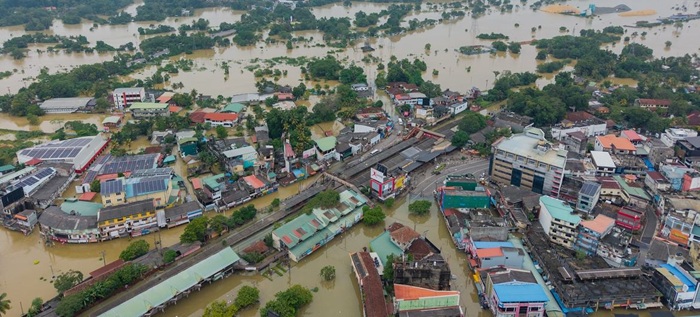
Nearly 1,000 people have been killed or remain unaccounted for in the last week’s weather violence, due to the direct impact of Cyclone Ditwah, named after a picturesque lagoon in war‑ravaged Yemen. Prior to this, the country—particularly the low‑lying areas of Colombo District—was devastated by floods in 2016, only to be hit again in 2017 by Cyclone Mora.
According to records, more than 18 cyclones—six of them severe cyclonic storms—are known to have crossed Sri Lanka during the past 140 years.
There is very little Sri Lanka—or even the most advanced countries like the United States, China, or Japan—can do to prevent nature’s fury. But mitigation measures can certainly be taken to minimise damage when nature decides to send a powerful message: “You are reaping the consequences of what you did to the planet Earth.”
Despite nature’s fury, polluters continue to harm the planet and refuse to cooperate with United Nations efforts to keep the global temperature rise below 1.5 degrees Celsius. US President Donald Trump dismisses climate change warnings as a hoax created by China to hinder his country’s progress. He is elated when Arctic ice melts, because it opens paths for Big Oil to exploit previously untapped energy reserves in the Arctic.
When major polluters harm the planet through greed-driven industrial development, the devastating effects of their environmental crimes disproportionately hit countries that contribute least to global warming. This is why environmental justice activists are calling for a much fairer Loss and Damage Fund—to help vulnerable nations undertake the measures needed for disaster preparedness, mitigation, and response.
The harm countries inflict on the environment may vary in scope and size, but no country can absolve itself of the environmental sins it commits. This includes Sri Lanka, where government policies in the past have squeezed the country’s wetlands.
A 2023 World Bank report links the urban floods that often hit Sri Lanka to ill‑conceived development projects. “As the country’s urban population has continued to expand, so have development and construction projects that sprawl on the periphery of major cities and transportation networks. These urban sprawl patterns have encroached on the island’s ecosystem of wetlands, which serve as a highly effective natural barrier against floods, while also functioning as natural air conditioners, purifiers of water and air, carbon sinks, agricultural havens, and safe harbours for biodiversity.”
Yet, the capital’s main fish market and vegetable market were relocated to what was once a flood‑retention area in Peliyagoda. In politically driven land‑distribution programmes, environmental concerns received zero attention. To win votes, politicians freely allowed illegal settlements to emerge in state wetlands. Colluding in these unlawful settlement‑building activities were the local councils, which asked no questions about the legality of the houses.
It is still not too late. The occupied wetlands can be retrieved if the government, with financial help from international donors, provides accommodation for these wetland dwellers in high‑rise apartments built on elevated ground.
At a workshop the non‑profit Asia Pacific Alliance for Disaster Management (APAD-Sri Lanka) held in Colombo some years ago, an expert recalled how the British colonial rulers devised a flood‑mitigation plan for Colombo after commissioning a study. The plan, still viable, called for the construction of more canals to carry the Kelani River’s water to the sea, but it remains unimplemented.
During the Ditwah disaster, experts and victims alike questioned why the river mouths were not widened or why sluice gates were not opened in a controlled manner during the days before Ditwah made landfall. These questions raised serious doubts about the expertise and capabilities of the state’s disaster management agencies.
Have they been affected by the 2022 brain drain?
With lessons learnt, especially after the 2017 disaster, the then government did pay attention to disaster mitigation. But sadly, like many well‑intended government programmes, the disaster‑mitigation efforts also suffered a severe blow due to the 2022 economic crisis.
The World Bank’s 2023 report notes that even though the Bank’s GFDRR (Global Facility for Disaster Reduction and Recovery) support has provided a valuable framework for the implementation of nature‑based solutions (NBS) to address flooding and landslides in Sri Lanka, the 2022 political and economic crisis severely impacted the state’s ability to carry |
out these measures.
It is too early to throw the government into the floodwaters for what it did not do to mitigate the Ditwah disaster or to place the president on a pedestal for post‑disaster measures. However, a flood of footage showing the President leading post‑landfall operations, with none showing pre‑disaster preparations, raises serious questions.
It is alleged that the government did not heed weather warnings issued since November 12 and acted only when Ditwah was about to make landfall — a charge it vehemently denies. Critics claim that there was little or no action even after a BBC weather report on November 25 warned of up to 500 mm of rainfall for Sri Lanka.
Amid such accusations, the silver lining among the dark clouds was the government’s anti‑corruption commitment, which stands in contrast to the record of previous governments. With the Helping Hambantota scandal—the alleged misappropriation of tsunami aid—still vivid in the collective memory of Sri Lankans, the present government seems above suspicion. People are confident it will spend every dollar received for the multibillion‑dollar rebuilding effort with accountability.
That said, the government also needs to be questioned for the lack of priority given to disaster preparedness. It is over‑focused on the rupees‑and‑cents side of the economy—perhaps, rightly so, given the gravity of the economic collapse in 2022. But should it not realise that no field is unconnected with the economy and that what is required is a holistic approach to economic growth? Its Clean Sri Lanka initiative may be wrapped in environmental rhetoric, but it is fizzling out as a mere beautification tamasha.
Moreover, while the country was drowning in sorrow over the loss of lives and infrastructure damage due to Ditwah, the Ministry of Environment budget was passed without a vote or debate on Tuesday. The government’s disaster‑response approach appears ad hoc. The system in place is woefully inadequate. While landslides occurred in some areas, people stayed put in other landslide‑prone areas, only to be buried under mounds of mountain earth. The so‑called early warning system did not serve them at all.
At the recently held COP30 conference in the Amazon city of Belém in Brazil, Sri Lanka was low‑key, though it duly submitted its Nationally Determined Contributions (NDC) plan and emphasised a green push in the 2026 budget it presented on November 7.
In the days and months ahead, the government’s focus will be on disaster recovery. But it is equally important to strengthen the country’s disaster‑preparedness capabilities by studying and adopting success stories from around the world. Strict measures are also needed to restore the wetlands and relocate people to safer ground, with local councils empowered to dismantle any building that comes up in flood‑retention wetlands and landslide‑prone areas