
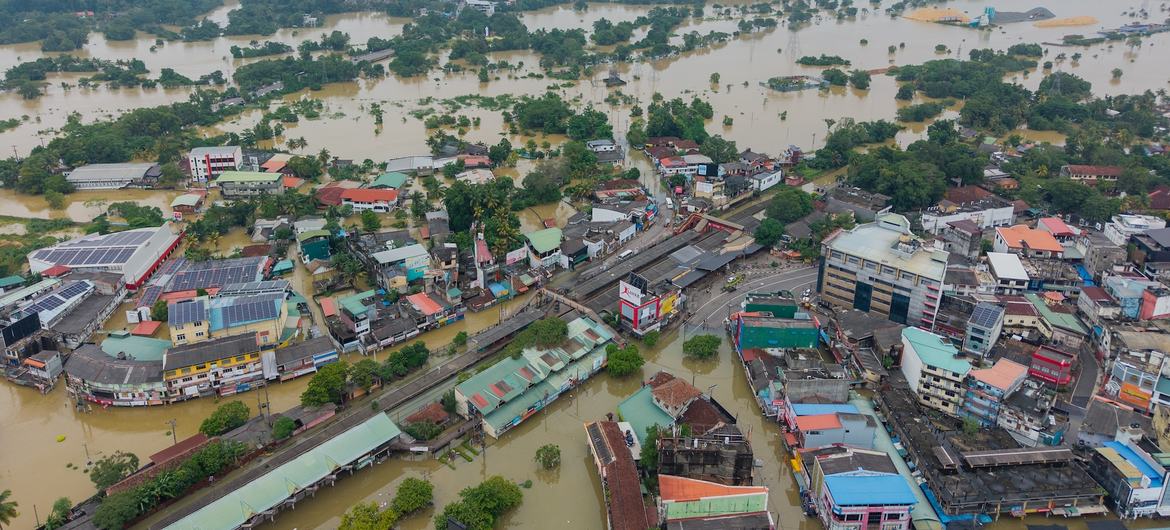

Colombo, 14 January 2026 – Nearly all communities affected by Cyclone Ditwah in Sri Lanka suffered damage to homes, roads and other critical infrastructure, according to a new United Nations Development Programme (UNDP) assessment released on Wednesday, underscoring the scale of recovery needs and the urgency of accessible financing for the most vulnerable.
The qualitative assessment, based on key informant interviews with 510 local officials, business leaders, and community representatives across 85 divisional secretariat divisions in the 22 most affected districts, found that 95% of respondents reported damage to residential, transport, industrial or community infrastructure within their area, with housing and roads most frequently cited.
Cyclone Ditwah struck Sri Lanka on 26 November 2025 and is the country’s deadliest disaster since the 2004 tsunami. An initial UNDP geospatial analysis released in December 2025 estimated that floodwaters inundated nearly 20% of the country’s land area, exposing approximately 2.3 million people. Building on this analysis, the qualitative assessment findings point to deep and widespread recovery needs, with many communities lacking the materials, labour, and financing required to rebuild.
“We commend the Government of Sri Lanka’s announcement on plans to provide LKR 95 billion in support to MSMEs, including a 3% concessional loan scheme, which is a crucial step in accelerating recovery. At the same time, it is essential that we prioritize support for the many that operate outside formal systems—those who often remain unseen yet form the backbone of the local economy,” said Azusa Kubota, UNDP Resident Representative in Sri Lanka.
“The RAPIDA assessment underscores the importance of moving beyond short-term humanitarian assistance toward a comprehensive approach to early recovery and resilience-building. This is vital to ensure vulnerable populations do not fall back into poverty and get trapped in the cycle. Investing in recovery efforts that strengthen local economies—including targeted support for the informal sector—will be central to building disaster resilience and secure sustainable livelihoods for all.”
UNDP’s assessment highlights widespread economic fallout. A large majority of respondents (93%) reported that livelihoods had been affected in their area, citing crop and livestock losses, job losses and business closures, including in the informal sector, which employs a large share of Sri Lanka’s workforce. Key recovery needs include support for micro enterprises, access to low interest loans and capital for small businesses to rebuild their infrastructure and stocks.
More than half of those interviewed reported that vulnerable groups, such as older people, persons with disabilities and female-headed households, were among those affected. The most common coping mechanisms included government aid or support (reported by 76% of respondents), followed by assistance from international organisations at 45%, and informal lending at 40%. These patterns point to rising household debt stress, with implications for both household welfare and the pace of recovery for micro and small enterprises.
Respondents also identified shortages of construction materials, limited availability of skilled labour, and funding constraints as obstacles to rebuilding damaged infrastructure, while citing delays in approvals and weak coordination between institutions as slowing recovery efforts.
Environmental and health risks emerged as additional concerns, with local officials reporting water contamination, soil erosion, and damage to ecosystems, pointing to longer-term climate and public health impacts.
Sri Lanka, like other countries in South Asia, is increasingly exposed to extreme weather events linked to climate change, including floods, cyclones and prolonged droughts.
UNDP said the findings highlight the need for continued support to restore infrastructure and livelihoods, particularly for informal workers and small businesses, while strengthening the climate and disaster resilience of enterprises and industries as the country transitions from emergency relief to recovery and reconstruction.
Sunday Times Reports
720,000 buildings across the country affected by Cyclone Ditwah, says UNDP report
- Says areas with the greatest recovery needs are where the cyclone impacted existing vulnerabilities
- District Secretaries and Grama Niladharis, face logistical hurdles when administering compensation
By Ishu Bandara
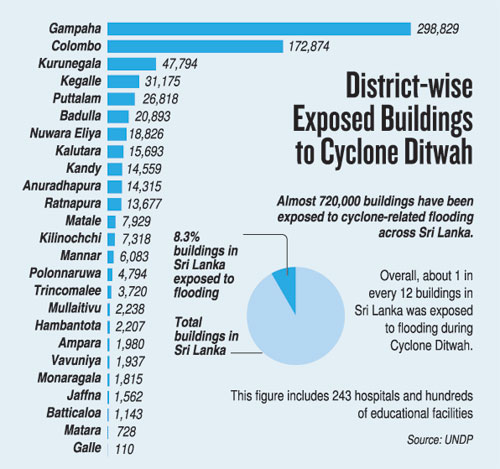
One in every 12 buildings in Sri Lanka was damaged by flooding during Cyclone Ditwah, an analysis report issued by the United Nations Development Programme (UNDP) has revealed. It estimates nearly 720,000 buildings across the country were affected including 243 hospitals, and hundreds of educational facilities. The UNDP cited Health Ministry data for the number of affected hospitals.
At the divisional secretariat level, Ja Ela in the Gampaha District recorded the highest number of affected buildings, with a total of 44,000 structures. Other areas with significant impact include Kolonnawa and Kaduwela in the Colombo District, as well as Katana and Wattala in the Gampaha District, each with around 35,000 buildings.
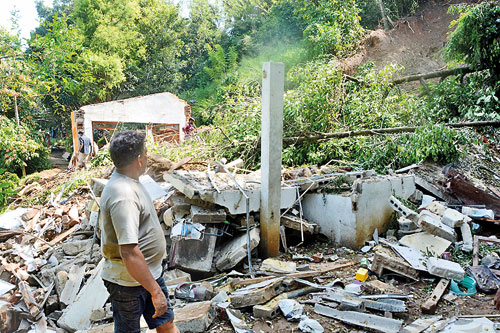
A home destroyed in Wattegedara
The report also states that the areas with the greatest recovery needs are where the cyclone impacted existing vulnerabilities. This was visible in the upcountry and the northern, western, eastern, and central regions. Among the divisional secretariats with the highest recovery needs are Mundel and Arachchikattuwa in the Puttalam District, and Kandavalai in the Kilinochchi District.
Puttalam District Secretary Indika Silva told the Sunday Times that the disaster affected 24,553 families, including 47,935 individuals. Nearly every part of the district was impacted, with 546 out of 548 Grama Niladhari (GN) divisions being affected. The district also recorded 38 deaths and three missing persons.
According to Mr. Silva, 582 structures were fully damaged and 9,990 partially damaged. A total of 1,987 families require new land for resettlement. This number included 278 families whose original land is no longer deemed safe to live in and 1,184 families with partially damaged homes in high-risk areas.
He further said “Around 525 families must be moved from ‘Villu’ areas, which have remained underwater for nearly two months due to unprecedented rainfall. In Mundel (Mundalama), several houses were completely lost to sea erosion.”
Highlighting the challenges faced by Grama Niladharis in the district, Mr. Silva said, “Some GN officers were under extreme pressure and even faced physical threats, some from people pointing knives at them demanding compensation payments. In one division, over 3,000 appeals were filed for the Rs. 25,000 cleaning up grant, but a single officer can inspect only about 50 houses a day. Relief efforts are further hindered because one-third of the district’s 3,100 government officials were themselves affected by the disaster. In Arachchikattuwa, the entire staff, including the Divisional Secretary, lost personal belongings and had to work in borrowed clothing.”
Despite these challenges, he added, “Over Rs. 2.2 billion has already been distributed for the immediate Rs. 25,000 cleaning grants, and another Rs. 1.5 billion for damaged household goods.”
The UNDP report further revealed that the cyclone resulted in 1.1 million hectares of flooding across Sri Lanka – equal to about 20% of Sri Lanka’s land mass.
The biggest flood in the country occurred in Dimbulagala Secretariat (Polonnaruwa District), with over 23,000 hectares being submerged. Significant flooding was also seen in Kandavalai (Kilinochchi), Maritimepattu (Mullaitivu), and Welikanda and Medirigiriya (Polonnaruwa).
Pre-existing vulnerabilities in districts such as Batticaloa, Ampara, Mullaitivu, Kilinochchi, Anuradhapura, Puttalam, Badulla, and Nuwara Eliya worsened the impact. Combined with flood and landslide-prone terrain, the cyclone has created a deep and lasting crisis, highlighting the need for early recovery through livelihood support, debt relief, restored transport links, and infrastructure rehabilitation, the report highlighted.
Nuwara Eliya District Secretary, Thushari Thennakoon commenting on the situation said: “The disaster has affected 60,208 individuals from 17,941 families. The death toll stands at 81, with 32 people still missing. Structural damage is widespread, with 661 houses fully destroyed and 3,703 partially damaged.”
She said the government aims to complete the resettlement process within one year.
As noted in the UNDP report, heavy rainfall in the central highlands, particularly in Nuwara Eliya, Badulla, and Kegalle triggered landslides, isolating rural communities and damaging access roads rather than causing widespread flooding.
Ms. Thennakoon said there are currently 46 safety centres operating in the district, while new camps have been established in Nildandahinna and Walapane to accommodate residents facing renewed risks.
“Residents are placed on alert to move when rainfall reaches 100mm, with immediate evacuation recommended at 150mm,” she said.
Badulla is one of the districts highlighted in the UNDP report, where intense rainfall created severe difficulties to local communities due to disruptions caused by landslides.
Badulla District Secretary Prabath Abeygunawardana, told the Sunday Times that the distribution of the initial relief grants was nearly complete while long-term resettlement plans for more than a thousand families reamained a challenge.
According to Mr. Abeygunawardana, around 150 to 160 families in the estate sector, who live in line houses, face unique difficulties as they lack the means to rebuild on their own. To address this, the government is holding talks about constructing dedicated housing complexes in Mahiyanganaya (two sites), Badulla, and Passara.
He also expressed serious concern about the current disaster management structure and the the difficulties faced by field officers. “Field officers are still working manually without modern tools,” he said, strongly advocating the provision of tablets to Grama Niladhari (GN) officers to replace slow, manual record-keeping. He also called for the merger of the Disaster Management Centre (DMC) and the Disaster Relief Service Centre into a single, stronger institution to speed up resource allocation.
Mr. Abeygunawardana further proposed the construction of permanent safety centres in at least seven divisional secretariats to avoid the repeated disruption to education by using schools as temporary relief camps.
The UNDP report also highlights weak coordination among government agencies, leading to delays in approvals and technical assessments.
The report says Cyclone Ditwah has already produced more than 25,000 tonnes of non-construction waste and over 60,000 cubic metres of construction debris. These amounts are expected to rise as more affected areas are checked.
Officials say it is difficult to work with many government agencies, especially when removing and dumping debris. The public, however, wants results and expects the government to work together to solve the problems and recover from the disaster.